
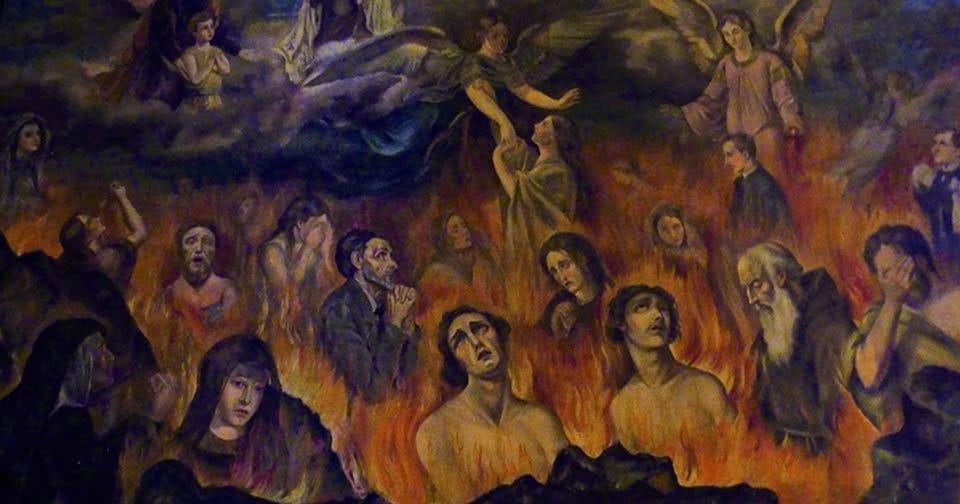
The Twelve Months Sanctified by Prayer: November, Month of the Souls in Purgatory by M. L’ABBE A. RICARD, D.S.G. Translated from the French. 1877 November 1 The Sufferings of Purgatory Compared to the Sufferings of This Life.
.
Prelude.
.
Let us listen to the mournful cries escaping from the prison of expiation, where the inexorable justice of God detains those souls, who must be perfectly cleansed and purified before He admits them into His paradise.
.
Meditation.
.
The pain of some in Purgatory greatly surpasses the cruellest and most insupportable pains of this life. “Everything that we could see, imagine, or feel of the sufferings of this life,” says St. Augustine, “is very little indeed, compared to the flames of Purgatory.” Venerable Bede assures us that neither the torments of the martyrs nor the punishments of criminals can approach the pains of Purgatory. St. Thomas Aquinas goes still further, for with all the authority of his genius and his science he affirms that the least of the sufferings of Purgatory is greater than the greatest suffering of this. life, and the same Doctor shows us again the extent of the torments of Purgatory, when he says, “that it is the same fire which torments the damned in hell as the just in Purgatory. The pain of sense in hell does not differ from that in Purgatory, except that the torments of hell will never end, and those of Purgatory will.
.
These are terrible considerations, and we must be very blind or very frivolous to expose ourselves willingly to the sensible torments of Purgatory by the facility with which we allow ourselves to commit faults which, without being mortal, nevertheless offend our loving God, and irritate His justice, and these same considerations should strongly urge us to show our compassion for these poor souls, who are suffering such torments in Purgatory, by the fervour and perseverance of our suffrages in their favour.
.
Resolution.
.
Bear willingly all the little contradictions and sufferings of this life,
and offer this resignation in exchange for the fearful pains which await us in Purgatory.
.
Aspiration.
.
“Rebuke me not, O Lord, in Thy indignation; nor chastise me in Thy wrath.” (Psalm xxxvii. 2.)
.
Example: An Hour in Purgatory.
.
Two religious full of piety and zeal for their sanctification, and having the same attraction for prayer, recollection, and penance, were united by such an intimate friendship, that these Latin words could be applied to them: “Hi duo corporibus mentibus unus erant” “These are two bodies, but only one soul.” Their hearts were filled with zeal for the glory of God, and they laboured earnestly for the salvation of their neighbour, striving to observe their rule with the utmost perfection. Suddenly one of them fell ill, and caused great anxiety for his life. An angel of God appeared to him, and told him that he would die and would expiate in Purgatory the pain due to his faults until a Mass should be celebrated for him, and that then he would enter heaven to receive the reward of his zeal and fervour. These tidings filled the holy monk with joy, and, calling his friend, he related his vision, and told him of the death which would soon release him, and of the very short time he would have to remain in Purgatory, then he implored him, by the brotherly love which had united them, to offer up the holy Sacrifice as soon as possible after his death, so that he might soon enjoy eternal bliss, and, deeply affected by the thought of losing so dear a friend, he promised to fulfil his wish, and he was faithful to his word; for the monk dying the next morning, he had hardly closed his eyes, when he hastened to the sacristy to vest himself in the sacred ornaments, and offer up the holy sacrifice. Mass was hardly finished when during his thanksgiving his friend appeared to him, radiant with happiness, but still retaining a shade of sadness and suffering on his countenance. “Brother,” be said to him, “where then is your faith? How have you kept your promise? You deserve that God should have no more pity on you.” “And why?” he replied. “Why, have you not left me a year and more in the midst of that avenging fire without any of my brothers having said the Mass which would have delivered me?” “What can you mean?’ cried the religious. “I have but just taken off my sacerdotal vestments; you have left the earth but a short time ago; your funeral has not yet taken place, and your corpse is still amongst us.” Then his friend, looking at him, exclaimed, with a deep and mournful sigh: “Oh, how frightful, then, are those sufferings, since they have made me consider a short time a year. I thank you, brother, for your zeal in accomplishing this work of charity. I am going to heaven to bless God, and to implore of Him to return what you have done to me, so that we may one day be united in our eternal happiness as we had been in the days of suffering and warfare. I thank you again then, brother, and do you take courage.”