
The Origins of The laudes regiae: Christ conquers.
.
Christus vincit. Also called the laudes regiae throughout history, Christus vincit is an acclamation which asserts Christ as the king of kings. It pulls no punches, calling out: Christus vincit, Christus regnat, Christus imperat. “Christ conquers, Christ reigns, Christ commands.
.
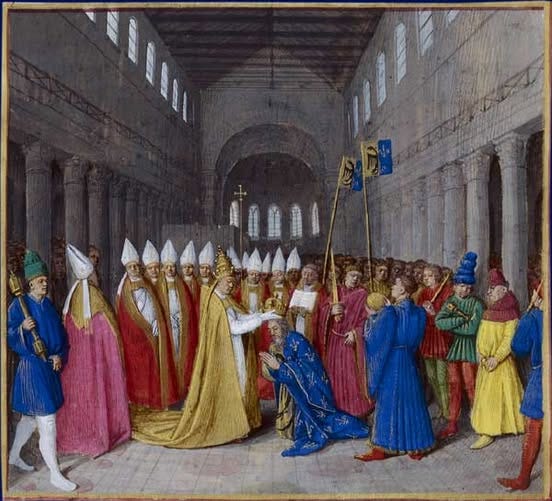
Christus vincit is an acclamation of a style that reaches back to ancient Rome. Praises of victory and honor were shouted or chanted to Roman generals, consuls, or emperors who entered the Eternal City in triumph after a great battle. Charlemagne, a barbarian king who fashioned himself a ruler in the tradition of the old Empire, adopted Roman traditions such as the acclamations for his own use. It’s said that at his coronation as Emperor of the Romans in A.D. 800, he adopted Christus vincit, Christus regnat, Christus imperat for his own personal motto. Those words formed a chant which was used in the coronations of the Holy Roman Emperors for centuries hence.
.
It’s no surprise that the laudes regiae were most popular in Charlemagne’s native France. Not only was it sung during the holy anointings of the French kings, it was also featured every year at the Cathedral of Notre-Dame-de-Paris. On Easter Sunday, the King himself would process into the cathedral (considered the King’s own parish), with the royal praises made both for him and the risen Christ. The French tradition then made its way to England courtesy of the Norman Conquest. Thus, the laudes regiae would also be heard in the coronations of the Kings of England from the time of the Conquest to the Reformation. The oldest manuscript we have of laudes regiae in England is for the coronation of William the Conqueror’s wife, Matilda, as queen in 1068.
.
Christus vincit continued to appear in the coronations of the Popes well after most of the crowns of Europe had fallen....
The feast was originally established in 1925 by Pope Pius XI in the encyclical Quas Primas. It was a response to the growing trends of communism, fascism, nationalism, and all the other -isms that would blow up into World War II. The date was to be on the last Sunday of October for two reasons: first, on a Sunday to ensure maximum attendance by the laity, and second, at the end of October so it would complement All Saints and All Souls Day, making a sort of triduum of holy days.
.
From The Modern Medievalist