
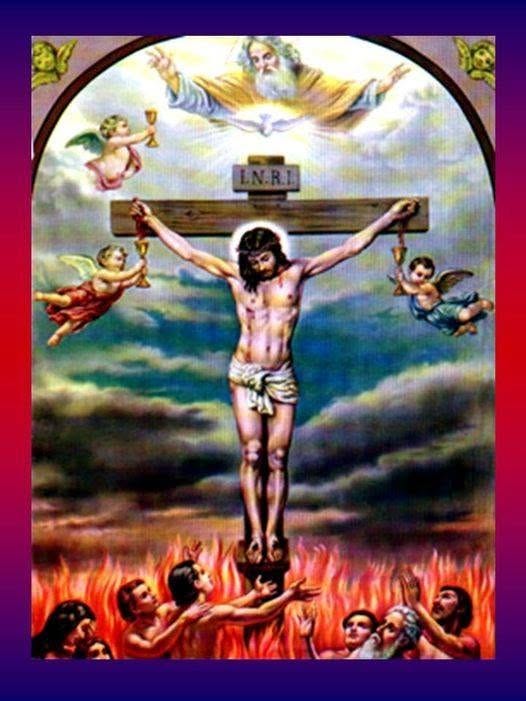
The Heroic Act of Charity
.
Prelude
.
The Heroic Vow of Heroic Act of Charity towards the Holy Souls in Purgatory is an act which consists in giving to them all the satisfactory works, that is, the value of these works of our lives, and the suffrages which we will be given after our death, without reserving anything at all with which to discharge our own debts. We do not do this of our own, but instead deposit our offering with the Blessed Virgin Mary that she might distribute them, as the Mediatrix of All Graces, according to her good pleasure, to those souls she chooses to deliver from Purgatory.
.
This Heroic Act is an absolute donation, for we relinquish our will to hers on behalf of the Holy Souls; we offer this Act to Almighty God through her, we offer all our meritorious thoughts, words, deeds and all that we suffer in union with the grace of God during our life here, without exception; this offering includes any suffrages and works that another may offer for on our behalf after our death. A little but important note: the merits of our good works belong to us alone, in the glory of Heaven, and cannot be given to anyone else; it is the satisfactory value alone that we offer.
.
A Traditional Form of the Heroic Act
.
“O Holy and Adorable Trinity, desiring to co-operate in the deliverance of the Souls in Purgatory, and to testify my devotion to the Blessed Virgin Mary, I cede and renounce in behalf of those Holy Souls all the satisfactory part of my works, and all the suffrages which may be given to me after my death, consigning them entirely into the hands of the most Blessed Virgin, that she may apply them according to her good pleasure to those Souls of the faithful departed whom she desires to deliver from their sufferings. Deign, O my God, to accept and bless this offering which I make to Thee at this moment. Amen.”
.
The Sovereign Pontiffs, Benedict XIII, Pius VI, and Pius IX have approved this Heroic Act, enriched it with indulgences and privileges, of which the principal are the following: 1. To priests who have made this act the indult of a privileged altar every day in the year. 2. The simple faithful can gain a plenary indulgence, applicable to the Souls in Purgatory only, each time they communicate, provided they visit a church or public oratory, and there pray for the intention of His Holiness. 3. They may apply to the Holy Souls all those indulgences which are not otherwise applicable by virtue of concession, and which have been granted up to the present time, or which shall be granted in the future. (Pius IX, Decr. 30 Sept. 1852).” [Web master note: Today this carries a partial indulgence as I understand it although cannot find in the 1988 Enchiridion of Indulgences. This Act does not prevent one from praying for oneself and others here in the usual manner and need.] “I advise all true Christians,” says Father Mumford (Charity to the Departed), “to cede with holy disinterestedness to the faithful departed all the fruit of their good works which are at our disposal. I do not believe that they can make a better use of them, since they render them more meritorious and more efficacious, as well for obtaining grace from God as for expiating their own sins and shortening the term of their Purgatory, or even of acquiring an entire exemption therefrom.” These words express the precious advantages of the Heroic Act; and in order to dissipate all subsequent fear which might arise in the mind, he add three remarks: 1. This act leaves us perfect liberty to pray for those souls in whom we are most interested; the application of these prayers is subject to the disposition of the adorable will of God, which is always infinitely perfect and infinitely loving. 2. It does not oblige under pain of mortal sin, and can at any time be revoked. It may be made without using any particular formula; it suffices to have the intention, and to make it from the heart. Nevertheless it is useful to recite the formula of offering from time to time, in order to stimulate our zeal for the relief of the Holy Souls by prayer, penance, and good works. 3. The Heroic Act does not subject us to the direful consequences of having to undergo a long Purgatory ourselves; on the contrary, it allows us to rely with more assured confidence on the mercy of God in our regard, as is shown by the example of St. Gertrude.
.
Saint Gertrude:
.
Venerable Denis, the Carthusian, teaches that St. Gertrude had made a complete donation of all her works of satisfaction in favor of the faithful departed, without reserving anything wherewith to discharge the debts which she herself might have contracted in the sight of God. Being at the point of death, and, like all the Saints, considering with much sorrow the great number of her sins on the one hand, and, on the other, remembering that she had employed all her works of satisfaction for the expiation of the sins of others, she was afflicted, lest, having given all to others and reserved nothing for herself, her soul, on its departure from this world, should be condemned to horrible suffering. In the midst of her fears our Lord appeared to her and consoled her, saying: “Be reassured, My daughter, your charity towards the departed will be no detriment to you. Know that the generous donation you have made of all your works to the Holy Souls has been singularly pleasing to Me; and to give you a proof thereof, I declare to you that all the pains you would have had to endure in the other life are now remitted; moreover, in recompense for your generous charity, I will so enhance the value of the merits of your works as to give you a great increase of glory in Heaven.”
.
PURGATORY EXPLAINED BY THE LIVES AND LEGENDS OF THE SAINTS by FATHER F.X. SCHOUPPE, S.J.