
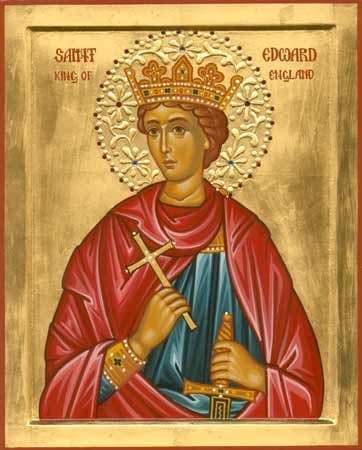
Saint Edward the Confessor from The Golden Legend by Jacobus da Voragine, 1527 Part 2
.
When the blessed King Edward had lived many years, and was fallen into great age, it happed he came riding by a church in Essex called Havering which was at that time in hallowing and should be dedicated in the honour of our Lord and Saint John the Evangelist; wherefore the king for great devotion lighted down and tarried while the church was in hallowing. And in the time of procession, a fair old man came to the king and demanded of him alms in the worship of God and Saint John the Evangelist. Then the king found nothing ready to give, ne his almoner was not present, but he took off the ring from his finger and gave it to the poor man, whom the poor man thanked and departed. And within certain years after, two pilgrims of England went into the holy land to visit holy places there, and as they had lost their way and were gone from their fellowship, and the night approached, and they sorrowed greatly as they that wist not whither to go, and dreaded sore to be perished among wild beasts; at the last they saw a fair company of men arrayed in white clothing, with two lights borne afore them, and behind them there came a fair ancient man with white hair for age. Then these pilgrims thought to follow the light and drew nigh. Then the old man asked them what they were, and of what region, and they answered that they were pilgrims of England, and had lost their fellowship and way also. Then this old man comforted them goodly, and brought them into a fair city where was a fair cenacle honestly arrayed with all manner of dainties, and when they had well refreshed them and rested there all night, on the morn this fair old man went with them, and brought them in the right way again. And he was glad to hear them talk of the welfare and holiness of their king Saint Edward. And when he should depart from them, then he told them what he was, and said: I am John the Evangelist, and say ye unto Edward your king that I greet him right well, by the token that he gave to me this ring with his own hands at the hallowing of my church, which ring ye shall deliver to him again. And say ye to him that he dispose his goods, for within six months he shall be in the joy of heaven with me, where he shall have his reward for his chastity and for his good living. And dread ye not, for ye shall speed right well in your journey, and ye shall come home in short time safe and sound. And when he had delivered to them the ring he departed from them suddenly. And soon after they came home and did their message to the king, and delivered to him the ring, and said that Saint John Evangelist sent it to him.
.
And as soon as he heard that name he was full of joy, and for gladness let fall tears from his eyes, giving laud and thanksgiving to Almighty God, and to Saint John his avowry that he would vouchsafe to let him have knowledge of his departing out of this world. Also he had another token of Saint John, and that was that the two pilgrims should die tofore him, which thing was proved true, for they lived not long after. And at the feast of Christmas the king was sick, and on the day of the Innocents he heard mass in the new church of Westminster, which he had re-edified, and then he, giving thankings unto Almighty God, returned into his chamber sore sick, there abiding the mercy of our Lord. And all the lords, gentles, and commons were in great heaviness when they understood that the king might not live, remembering what wealth and prosperity the land had been in during his days, and what jeopardy it was like to stand in after his decease. Then all things were committed to the queen whom he loved specially, and she full diligently ministered to him all things necessary. And when he was so feeble by sickness that his natural heat was almost gone, he lay nigh two days in a trance, as a man that had been ravished, and when he came to himself again they that were about him marvelled greatly, for they weened verily that he should no more have spoken. Notwithstanding, after, he spake with a noble spirit these words: O thou merciful Lord God, that art infinite Almighty, in whose power all things be put, which changest realms and empires, if those things be true that thou hast showed to me, so grant me space and strength to declare them to my people, that if peradventure they give them to penance, they may have grace and forgiveness. Then Almighty God gave to him a new strength that passeth all man’s reason, and that might not be without miracle, for before that time he spake so soft that for feebleness he might not well be heard, and at that time he spake with a whole breast, these words following: When I was young and dwelled in Normandy, I loved well the fellowship of good men, for he that spake most religiously and goodly, with him was I most conversant. And among all others there were twain to whom I drew much for their honest conversation, and for the holiness of their life, sweetness of their manners and their comfortable words, whom I saw translated into heaven; for many years gone they died, and now they have appeared to me by the sufferance of God and have showed to me the state of my people, and what sins reign among them, and what vengeance shall be taken on them for their sins. priests have offended, for they minister the holy sacraments with unclean thoughts and polluted hands, and as an hired man and not as a very shepherd, defend not their sheep ne feed them. And as for princes and gentles, they be found false and untrue, and fellows to fiends, thieves, and robbers of the country, which have no dread of God ne honour him. And true law is a burden to them, and had in despite, and cruelness much used. And the prelates keep not righteousness, they correct not their subjects, ne teach ne inform them as they should do. And therefore our Lord hath now drawn out his sword of vengeance to smite his people. This punishment shall begin within this year both by sword and wasting this realm piteously. And then I began to sigh and mourn for the trouble that was coming to my people, and said: If they would be turned and do penance, shall not they have forgiveness and God shall bless them again ? And it was answered to me: The hearts of the people be so indurate and so blinded, and their ears so stopped, that they will not hear of no correction, ne they be not moved ne provoked by no benefits that our Lord giveth them. Then I asked if there were any remedy that might attemper the wrath of our Lord. To whom it was answered in these words: A green tree cut from his stock shall be divided from his proper root the space of three furlongs, and without man’s hand shall turn again to his old root, and take again his sap and flourisheth and bringeth forth fruit, and when this is done there may come remedy. And when this was said they were suddenly gone out of my sight.
.
There was about the king that time, the queen, duke Harold her brother, Robert, keeper of the palace, and Stigand, which had defiled his father’s bed. For whiles Robert, the archbishop of Canterbury lived, the said Stigand put him down and came in by simony, wherefore he was suspended by the pope. And afterward God took vengeance upon him, so that his belly brake and his bowels fell out, and so he died wretchedly. This Stigand gave no credence to the king’s words, but ascribed it to his age, and to the feebleness of the king, and made it but a fantasy, but others that were better advised, wept and sorrowed and wrung their hands, and sent to our holy father the pope, giving him information of the same vision. And our holy father wrote epistles to England exhorting the people to do penance, but his writing profited not. But when king Harold had broken the oath that he had made to duke William, therefor he was slain in battle, then they knew well that the prophecy af Saint Edward was come. For then the liberty of England made an end, and then came in bondship and thraldom. That time England was all changed, and I understand Saint Dunstan prophesied the same trouble coming, and after a certain time he promised comfort also. Wherefore this foresaid vision may be conveniently expounded as here followeth. The tree signifieth the realm of England, whose greatness and fairness betokeneth riches plenteous, and honour of England, of whom all worship proceedeth which worship hath proceeded of the true blood of the land, and of the true lineage which descended from Alfred, which our holy father the pope crowned and anointed king, as for the first king of the true line of England, unto this holy king Edward, by succession. The tree is cut down from the stock when the realm is divided and translated from one seed or lineage to another. The space of three furlongs is the time of three kings, that is to say Harold, William Conqueror, and William his son. The coming again of the tree to the stock without man’s help was when king Henry the first came into the realm, not by man’s strength but by the very true love of his commons. He took his sap and his very strength when he wedded Maud the daughter of the niece of Saint Edward, joining together the seed of England and of Normandy, and by the tree flourished, whom Maud the empress sprang of their seed, and it brought forth fruit when of her came Henry the second, and thus these two people were joined together. If this exposition displease any man, let him expound it better, or else let him abide a time till it be fulfilled, so that the prophecy of king Edward accord to the prophecy of Saint Dunstan.
.
This holy king Saint Edward, knowing that his hour drew nigh, spake to them that stood weeping about him and in comforting them said: Forsooth if ye loved me ye would pray that I should pass from this world to the father of heaven, there to receive the joy which is promised to all true christian men. Put ye away your weeping and speed forth my journey with prayers, with holy psalms and with almsdeeds. For though mine enemy the fiend may not overcome me in my faith, yet there is none found so perfect but he will assay and tempt to let or to fear him. And then he commended the queen to her brother in commending her virtues unto his lords, and declared to them their pure chastity. For she was to him in open places as his wife, and in secret places as his sister. And he commanded also that her dowry should be made sure to her, and they that came with him out of Normandy should be put to their choice, whether they should abide still in England and to be endowed with livelihood after their degree, or else to return again into Normandy with a sufficient reward. And he chose his place for his sepulture in the church of Saint Peter, which he had new builded, and said he should not long abide in this world. And when he beheld the queen and saw her weep and sigh among, he said to her ofttimes: My daughter, weep not, for I shall not die, but I shall live, and shall depart from the land of death, and believe to see the goodness of God in the land of life. And then he set his mind all in God, and gave himself wholly to the faith of the church, in the hope and promises of Christ under the sacraments of the church. And among these words of praising, he yielded up his spirit unto God, in the year of our Lord one thousand and sixty-six, when he had reigned in this land twenty-three years and six months and twenty-seven days, the fourth day of January. And as his cousins and his lovers stood about this holy body when the spirit was passed, they saw a marvellous beauty, and a heavenly sight in his face. And when they looked on his naked body, they saw it shine with a marvellous brightness for the clearness of his virginity. And then they wrapped the holy body in palls and buried it with great reverence and worship, and largely alms were given for him. And all the lords, spiritual and temporal, were present at the burying of him, thanking God of the great benefits that he showed in this land during the life of the holy saint and king, Saint Edward. Wherefore laud, glory and honour be given to Almighty God, world without end. Amen.
.
The eighth day after his burying there came a cripple to his tomb to be holpen of his great disease, which many times afore had received alms of the king’s hand, and he had been washen of the king’s hand on Cene-Thursday. Notwithstanding, the miracle of his curing was prolonged by the provision of God, and not showed in his lifetime, because that many miracles God showed for him, in like wise he would show after his death. This cripple was called Ralph, and was a Norman born, and the sinews of his arms were shrunken together, and his feet were drawn up to his buttocks that he might not go, neither on his feet ne on his knees, but sat on a hollow vessel in manner of a basin, drawing his body after him with his hands. And when he came to the tomb, he besought Almighty God and Saint Edward devoutly that he might be cured and healed of his disease, which in his lifetime had most lived by his alms. And when he had continued awhile in his prayers other people that had compassion of him, prayed for him also, and at the last he lifted himself up, and felt his sinews loosed, and then he arose up and stood on his feet, and felt himself made perfectly whole for to do what he should. We have read of the virtues that Saint Edward had in healing blind men in his living, which our Lord hath not withdrawn from him after his death. It happed that thirty days after his burying, there came to his tomb a man which had but one eye, leading after him six blind men, and each of them held other by the skirt. And all they devoutly prayed to God and to Saint Edward that they might have their sight, and to be delivered of the great misery that they stood in, and much people came thither for to see what should befall of this thing. And when they saw how heartily these blind men prayed, then all the people being moved with pity, kneeled down devoutly, and prayed for them to God, and to this holy saint. And anon as they had ended their prayers all they received perfectly their sight. And then each of them that had been blind looked fast on each other, and thought it a new world with them. And each enquired of other, if they might see, and they said yea. And all kneeled down, thanking God full heartily that, by the merits of Saint Edward he had restored to them their sight perfectly, and also to their leader, which had but one eye at his coming, and had sight of the blind eye also, and so all had their perfect sight. And after, they returned home each into his country, giving laud and thankings to God and to this holy king.
.
After this Harold Harfager, king of Norway, and Tosti, brother of king Harold of England, came with a great navy and a great host, and arrived in Humber, and there made war, intending to conquer this land. Howbeit, the people began to resist them, but they were not of power to overcome them. And when Harold understood this, he raised a great multitude of people to withstand them. Then Saint Edward on a night appeared to a holy monk, which was abbot of Rumsey, and bade him go and tell to Harold that he should overcome his enemies, the which intended to destroy and consume this realm of England, and say to him that he dread not, for I shall so conduct him and his host, that he shall have victory, for I may not see ne suffer this realm of England to be destroyed. And when thou hast told to him this, he will not believe thee, wherefore thou shalt prove thy vision in this manner. Let him think and set his mind on what thing he will, and thou shalt tell him what he thinketh, for God shall show that to thee, and then he shall give credence to thy words. On the morn the abbot of Rumsey, named Alexis, went to king Harold and told to him this vision, and how he should by the aid of Saint Edward overcome his enemies. And when he heard it first, he supposed it had been a fantasy, and when he showed to him his privy thought, then he gave faith thereto and went to the battle, howbeit that he was then sick in his groin of a pestilence botch, and slew Tosti, his brother, and Harold Harfager, and right few or none escaped alive, from the battle. Wherefore the Englishman thanked God and Saint Edward of their victory.
.
In the monastery of Westminster there was a fair young man which was blind, whom the monks had ordained to ring the bells, and he had a custom daily to visit the tomb of Saint Edward with certain prayers. And on a time as he prayed there, he fell asleep, and he heard a voice that bade him go and ring to the last hour. And when he awoke he saw Saint Edward going tofore him like a king with a crown on his head, and had marvellous light about him. And he beheld him till he came to the high altar, and then he saw him no more, ne the light, but he had his sight ever after till his life’s end, and then he told unto the monks how he was healed, and had his sight again by this miracle.
.
Of the Deposition of Saint Wulstan, and how he was restored again.
When William Conqueror had gotten all England, and had it under his power, then he began to meddle with the church, and by the advice of Lanfranc, the holy bishop Saint Wulstan, was challenged that he was not able of letters, ne of conning for to occupy the realm and office of a bishop, and was called tofore Lanfranc, and willed him to resign by the consent of the king to the said Lanfranc, archbishop, that a man of greater conning might occupy the dignity. To whom Wulstan said: Forsooth father, I know well that I am not worthy to have this dignity, ne am not sufficient to occupy so great a charge, for I knew well mine unconning at such time when I was elect thereto, but I was compelled by our holy father the pope, and by good king Edward, and sith it pleaseth the council that I shall resign, I shall gladly resign, but not to you, but to him that compelled me to take it. And he departed incontinent from the archbishop Lanfranc, and went straight to the tomb of Saint Edward with his cross in his hand, and he said to Saint Edward, as he had then been alive: O thou holy and blessed king, thou knowest well that I took this charge on me against my will, but by constraint of the pope and thee I obeyed to take it, and it now so is that we have a new king, new laws, and giveth new sentences, in reproving thee of thine error for so much as thou gavest it to me, simple and unconning man, and me, for the presumption that I would consent to take it. That time thou mightest well have been beguiled, for thou wert a frail man, but now thou art joined to God, whereas thou mayst not be deceived. Thou gavest to me the charge, and to thee I here resign it again. And with that he fixed his staff into the hard stone of his tomb, saying: Take this and give it to whom it pleaseth thee. And the hard stone that lay upon his tomb resolved by miracle, and received his cross or pastoral staff, and held it so fast that it might not be taken out by man’s hand. And anon he did off the habit of a bishop, and did on a cowl, and stood among the monks in such degree as he did tofore ere he was bishop. And when word came, and was reported to them that had consented to his resignation, they marvelled greatly and were all abashed, and some of them went to the tomb and would have pulled out the staff, but they could not move it. And when the archbishop Lanfranc heard thereof he commanded to Gundulf, bishop of Rochester, to go and fetch to him the pastoral staff, but when he came he set hand on it and pulled at it, but the stone held it so fast that he might not move it, wherefore he was sore abashed, and came to Lanfranc, and told to him of this miracle. Then the king and Lanfranc were abashed and came both in their persons to see this thing, and there made their prayers. And after, with great reverence Lanfranc assayed and set hand on the staff for to have pulled it out, but it would not move. Then the king and the archbishop were sore afraid, and repented them, and sent for to seek Wulstan, whom they found among the monks and brought him tofore the king and the archbishop, who anon kneeled down and asked forgiveness. And Wulstan meekly kneeled down and prayed them not so to do to him, and humbly and meekly pardoned them and prayed the archbishop humbly to bless him. Then Lanfranc went to this holy man Wulstan and said: Brother, thy rightful simplicity hath been but little set by among us, but our Lord hath made thy righteousness to shine like as a day-star. But, brother, we have trespassed and erred in judging the good to be evil and the evil good, but our Lord God hath araised the spirit of Saint Edward which hath made void all our sentences, and thy simpleness is allowed tofore God. Wherefore come hither to thy king and ours, Saint Edward, and receive again thy staff which he hath denied to us, for we suppose he will deliver it to you. Then Wulstan the servant of God meekly obeyed with great reverence unto the archbishop, and went unto the tomb whereas the staff stood fast fixed in the stone, and kneeling down saying: O blessed saint of God, I here meekly submit me to thy sentence to whom sometime thou gavest and chargedst me unworthy with this staff. If it so please thee that thine old sentence abide, then restore to me again this pastoral staff, and if it please to thee to change it, so show to us whom thou wilt shall take it. And this said he set his hand humbly and with great reverence on the staff, and anon the hard stone resolved, and let the staff to go out, as it had been soft earth or clay. And when they that stood about him saw this great miracle they wept for joy in giving out largely tears, and asked him forgiveness, giving laud and praising unto Almighty God and to this holy saint king Edward. And ever after, king William had great devotion to visit the tomb of his cousin, Saint Edward, and did great cost toward the making of his shrine.
How his holy body was found incorrupt many years after.
After this miracle was showed, there was much talking of his holiness, and the devotion of the people increased daily more and more, so there were many diverse worshipful persons that desired to see this holy body. For some said that it lay incorrupt, and some said nay; and in this meek strife they gat licence of the abbot Gilbert to see it. And when the day was set that this holy body should be showed, there came thither many worshipful men and women of religion, among whom came Gundulf, bishop of Rochester, and this was six-and-thirty years after his burying that they opened his tomb. And when the stone was removed they felt a marvellous sweet savour, that all the church was replete thereof as though an odour aromatic had flowed out of the tomb. And they found the pall that lay next his body as whole and as fair as it was when he was buried; and when the pall was taken off they drew forth his arms, they moved his fingers and his toes, and they were bowing and whole as they had been newly buried. And in his flesh was found no corruption, but it was fair and fresh of colour, pure, and brighter than glass, whiter than snow, and it seemed a body glorified. And they feared to discover his visage, but Gundulf which was hardier than another, with devotion unbound his head, and the first that appeared was the fair hoar hair of his head, and then he thought to take some thereof for a relic, and with reverence and dread plucked thereat, but he could none have out, for they were as fast as they were when he was alive. Then said the abbot: Father, suffer him to lie in rest, and attempt not to minish that our Lord hath so long preserved and kept whole. Then the pall in which the holy body was wrapt was taken away, and another of the same value was fetched, and the holy body laid therein, and covered again his tomb with full great reverence, abiding the great resurrection.
.
How vengeance was showed to a damoiselle that blasphemed Saint Edward.
.
In the city of London there was a noble woman which was right conning in silk work, which was desired to embroider certain garments to the countess of Gloucester, which then was young, Iusty, fresh, and newly wedded, and would have them made in short space. And when the festal day of Saint Edward approached, this noble woman was sore troubled in her mind for she dreaded the indignation of the great lady if her garments were not ready at time set, and also she dreaded to work on the day of Saint Edward, for it was both sinful and perilous. Then she said to a young damoiselle that was fellow with her, and wrought in the same work: What think ye best now, either to displease this lady or else this good Saint Edward? And she answered: Is this not that Edward whom the churls of the country worship as he were a god? And she said yet more: What have I to do with him? I will no more worship him than if he were a churl. Then this noble woman was sore abashed and moved with her, that she said such words of blasphemy to this holy saint, and she all to-beat her for to be in peace, and she of frowardness blasphemed him more and more, and then suddenly was smitten with a palsy, so that her mouth was drawn to her ear, and also she had lost her speech, and foamed at the mouth like a boar, and grinded her teeth together marvellously, and was sore punished in all her members. And when this noble woman saw this, she was full heavy that she had beaten her, because Almighty God had so punished her, and wept full bitterly. And when it was known in the city, her neighbours came, some for to comfort her and some to wonder upon her so Iying. And then there came a worshipful man to visit her, and counselled that she should be carried by water unto the shrine of Saint Edward, and to pray to God there, that by the merits of the holy Saint Edward he would show some miracle for her. And when she was so brought thither, much people prayed for her, but they had not their intent anon, but abode in their prayers till midnight that matins began, and then they prayed the monks to pray for her. And when they had done matins they came to the shrine also and prayed for this damoiselle which lay there in full great pain and torment. And when the holy monks had prayed for her a good while, then this damoiselle arose up all whole, and demanded why they wept and made so much sorrow. And when they saw her mouth in his right place and all her members restored again, they were full of joy, and gave laud and thankings unto Almighty God and to his holy king and confessor Saint Edward.
.
How a monk was healed of a fever quartan.
.
In the abbey of Westminster there was a virtuous monk and conning named Gilbert, which was sore vexed with a fever quartan from the month of July to Christmas, and consumed like a dry image, whereof he prayed God to release his pain or take him out of this world. And on Christmas night he took heart to him and went to matins with his brethren. And when he heard the gospel, how a little child was born and given to us from the father of heaven, whose mother was a pure virgin, he had so great devotion that his mind was ravished with so great joy that he felt no disease two days after. After those two days the fever came again, and vexed him continually unto the feast of Saint Edward which is always in the vigil of the Epiphany. And that day in the high mass time he came to the tomb of Saint Edward and fell down plat in great devotion, and weeping, and said thus: O thou, my lord and king, how long wilt thou forget me? How long shall I suffer this pain? How long shalt thou turn thy face from me? Where be all the great miracles that our fathers have told to us, done in their days? Thou hast holpen many strangers, but me that am in thine own church thou forgettest and closest to me the gate of thy pity. Would God that I might die, I am nourished in pain and may not die, my life is sorrow to me, but it can have none end, and I desire death and dare not have it. What shall I strive with thee? But I beseech thee, good king, laudable prince, and sweet patron, move thy bowels of mercy on me, if it please thee give me health, or else let me die anon. And among these words the tears brake out of his eyes, and sobbings from his heart, that he could not speak with his mouth but with his affection. And when mass was done, he arose up from prayer all whole, and felt all his members marvellously refreshed with a new strength and entered in and asked after meat and drink, and anon he felt himself that he had received again his strength. And ever after he was moved with great devotion unto the glorious Saint Edward, by whose merits he was delivered from his sickness and disease.
.
And in like wise a knight named Gerin was healed that same day, a year after, of the fever quartan, which came that day unto the shrine and heard the same monk that had so been healed, which then was prior, make a sermon in which he told of the miracle, how he was whole. And after the sermon this knight thought he would not cease. but devoutly prayed this holy saint till he were whole, and abode there praying all that day and night following till the monks came to matins, whom he prayed to pray for him. And when they had prayed a good while he felt himself made perfectly whole, and then he with all the people gave thankings to our Lord, Almighty God, and Saint Edward, for his deliverance.
.
Also a nun of Barking, that had been sick twelve months, and nigh consumed away, had a vision on a night by which she understood that she should go to Saint Edward and be whole; and she making her prayers to Saint Edward. And at such time as her sickness came, she entered into her oratory and said the seven Psalms and Litany, and when she did so twice all her pain was gone, and she was made perfectly whole, and thanked Almighty God, which by the merits of Saint Edward had healed her, and soon after came to Westminster in pilgrimage, and there did show this miracle, and told how she was made whole.
.
Also there was a monk of Westminster which was accustomed to say every day five Psalms in the worship of God and Saint Edward, which monk was grieved with three manner sicknesses. For he had on his arm a congelation of blood in manner of a posthume, he had also in his breast a straitness that unnethe he might draw his breath, also he had in his foot a marvellous swelling and a great, that he might not go but with great pain. And when the yearly feast was hallowed, he saw his brethren go to the church at midnight for to ring the bells, and he was right sorry that he might not do the same. Notwithstanding he pained himself and went thither, and said the seven psalms. And when he had done, and saw his brethren ring merrily, he said in his prayer to Saint Edward: O thou my good king, I beseech thee to pray for me that I may have strength to do as I see my brethren do, for I commit me fully to thy might, and I believe verily that thou wilt suffer me no longer in this great disease. And when he had made an end of his prayers he arose up, and went to the bells for to ring them, and anon the posthume of his arm brake, and when the foul matter was out, he felt himself whole of that disease. Then his most pain was in his breast, and he went again to pray and to give thankings to God and to Saint Edward of the deliverance of his posthume. And there he prayed full devoutly that he might be delivered of the disease of his breast, and when he arose from prayer he felt his heart all whole from the sickness that he had in his breast. Then he felt no disease but on his foot, and when he came among his brethren in the fraitour, he told them how he was delivered from twain of his sicknesses, and when they saw him they marvelled greatly, and besought Almighty God and Saint Edward that he might be delivered of that disease in his foot. And at night, when he went to his bed, he put himself wholly in the merits of Saint Edward, and when he arose he felt no pain, but put down his hand to his foot to feel how it was, and he felt that the swelling was gone. He leapt out of his bed and told to his brethren, with full great joy, how he was made perfectly whole as ever he was. Then they were all full glad, and went with him to the church to give thankings and praisings to Almighty God, and to his holy confessor Saint Edward for these miracles, and for his deliverance from the three sicknesses, wherefore God be praised in his servant without end. Amen.