
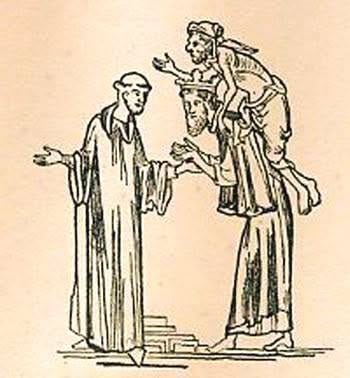
Saint Edward the Confessor from The Golden Legend by Jacobus da Voragine, 1527 Part 1 Many Healings Worked by Saint Edward.
.
Here followeth the Life of Saint Edward, King and Confessor
.
In old time the realm of England was greatly troubled with the Danes, so that in many kings’ days there could no peace be made, but continually war. And the Danes prevailed against England, and they brought it under their subjection, for their cruelty and tyranny was so great that, without sparing of anything, they burnt and destroyed.
But at the last it pleased Almighty God that this tyranny should cease, and sent of his grace unto this realm of England a peaceable king named Edgar, in whose birth angels sang that peace should be in his time, and so in his days was no war in England. Saint Edward, king and martyr, his son, reigned not long after him, for his stepmother did do slay him in his young age, because her son Ethelred should reign, and Saint Dunstan baptized Ethelred, and said because he defiled the fontstone that, he should live in great trouble, and so he did, for the Danes warred all his time. And this Ethelred wedded Earl Godwin’s daughter, on whom he gat Edmond Ironside. And after the death of that queen, he wedded the daughter of Richard, duke of Normandy, which hight Emma, by whom he had two sons, Alfred and Edward, which was a saint and confessor, of whom we purpose to speak. When king Ethelred was fallen in age, he made a parliament which of his two sons should be kings after him. And then by the provision of God it was concluded that Edward, which was not then born in his mother’s belly, should be king, and excluded Edmond Ironside and Alfred, which were the king’s older sons. And when the king had consented thereto, a general oath was made to perform the same in time coming. And after, when this child was born, all the land enjoyed in his birth, hoping to be greatly relieved by him. Yet always the cruelty of the Danes was so great, which the king so much doubted, that he sent the queen and his two sons Alfred and Edward, into Normandy, and took his oldest son Edmond with him to battle, to fight against the Danes. The sorrow was then great in England, for much people turned to the Danes against their own king, and without pity did burn and slay their own country with the Danes, among whom was slain Alphage, archbishop of Canterbury at Greenwich, and many other good men. And some bishops, priests, and men of religion, fled into secret places and deserts, where they devoutly prayed unto Almighty God for to have very peace in this land, but this war continued all the life of Ethelred, according to the prophecy of Saint Dunstan.
.
And after Ethelred, reigned Edmond Ironside his son, in full great trouble, for in his days no man durst trust other, ne open his courage to his neighbour, for that time each man appeached other of treason, to the intent that he might have his good. And they that were not of power to overcome their neighbours, turned unto the Danes against their own neighbours, and so, by the help of the Danes, they fulfilled their cursed purpose, and so there was much extortion, and much people slain in divers places, in houses, fields and ways, that the people unnethe durst bury them. Also in that time was great tyranny, murder, oppressing of women, as wives, widows, and maidens against their wills. And in this persecution Englishmen were nigh destroyed, and great desolation was in holy church, for monasteries, churches, and houses of religion were burnt and destroyed, which caused many to flee into wilderness, among whom the good bishop of Winchester, Brightwold, fled into the abbey of Glastonbury, where he daily prayed unto Almighty God for peace of this realm of England.
.
Our blessed Lord, seeing his meekness, showed to him a vision by which he was greatly comforted. For in a night, as he was in his oratory, he fell in a sweet slumber, and saw the glorious apostle Saint Peter with bright shining clothes appearing in a high place of dignity, and with him a seemly young man richly arrayed in clothing of a king, whom Saint Peter did consecrate and anoint into a king, and commending his chastity greatly, and his clean living. And it was showed to this bishop many years tofore, that this Edward should reign in this land, and the bishop, being abashed of this vision, desired of Saint Peter to know the vision thereof, to whom Saint Peter said the estate of this realm, and told that the fury and woodness of the Danes should cease soon after, and said that all this punishment was for the sins of the people, and God should purvey for a peaceable king, which shall finish all the woodness of his enemies the Danes. In whose time shall be plenty of peace, both to the church and to the land, and great abundance of corn and fruit. And this realm shall be prosperous in all things, and the people shall be of such conditions that other lands shall both love and dread them. The king’s name shall be Edward, which shall rule all manner things to the pleasing of God, and shall end his life in the love of our Lord graciously. And when this holy bishop awoke, he kneeled down and made his prayers with shedding of tears, and though that peace was not yet reformed, nevertheless he thanked Almighty God that he was certain that, by God’s grace, he should see it in his days, wherefore he went about and preached to the people for to do penance, and our Lord should show to us mercy, and give to us peace and all things plenteous. And in this war was the king slain by treason, and he was buried at Glastonbury. Then both his sons were brought to King Canute the Dane, to do with them what he would, and when he saw them he might not for pity slay them, but sent them over the sea to be slain there, so that he might reign in England peaceably when the rightful blood was destroyed. Notwithstanding, they were preserved and kept alive, and were conveyed to the emperor of Rome, the which kept them till Saint Edward was made king of England, and then he married the oldest of them to a cousin of his, because of the love that they had to King Edward, which was uncle to them. Then had King Canute the rule of England by strong hand, all law and good rule set aside. For in his days was full much trouble and robbery with other great oppressions and importable charges among the commonalty. For he dreaded no man except the two sons of the king, that were then with the emperor, wherefor his council would that he should wed the mother of them named Emma, to make the more alliance between them. And soon after, Alfred came to England for to speak with his mother, and anon as he was come over the sea into this land Earl Godwin came and welcomed him, and anon after slew him by treason, ere he came to the presence of his mother. For whose death Saint Edward made great sorrow. And while this holy child Saint Edward was in Normandy, he used a full good life, haunting ofttimes holy church, and loved and conversed many times with the company of holy religious men, and especially among holy monks. And used to pray and say in this manner: O good Lord, I have none help but thee only, my friends be gone from me, and they be become mine adversaries. My father is dead and my brethren be slain, my mother is wedded to my most enemy, and I am left alone, and daily they seek the means to slay me, but to thee, Lord, I am left poor. I beseech thee, Lord, to help me that am a fatherless child, for thou sometime helpedst marvellously Edwin and Oswald, which were exiled and ordained for to die. Thou defendedst them not only from death, but also thou, Lord, restoredst them again to their own kingdoms. O good Lord, I beseech thee and pray thee to keep me safe, and bring me into the kingdom of my father. Thou shalt be my God, and Saint Peter the apostle my patron, the relics of whom, by the grace of God, I purpose to visit and to honour in the same place where they now rest, if thou, Lord, send to me life, health, opportunity and space.
.
And when King Canute had reigned in England twenty years, having two sons by the said Emma, that is to wit, Harold and Hardicanute, he died, and when his first son had reigned four years, he exiled his own mother, and died soon after. And after him reigned his brother a little time, and died also, as our Lord had ordained, and then was England delivered from the grievous tribute and thraldom of the Danes. And then the lords and the commons of England remembered the oath that they made in the parliament, which sware that Edward, which was then in his mother’s womb, should be their king, and anon sent into Normandy for this holy child Edward. And the lords and the commons received him with great gladness, and then the archbishop of Canterbury and the archbishop of York, with other bishops, did consecrate him, anointed and crowned him king of England. O good Lord! what joy and gladness was then in England. For when the old felicity of this land was almost despaired, then it was kindled again by the coming of this blessed king Saint Edward. Then had the commons rest and peace, and the lords and gentlemen rest and honour, and then holy church received all her liberties again. Then was the sun lifted up, and the moon set in his order, that is to say, priests shined in wisdom and in holiness. The monasteries flourished in devotion by holy religion. The clerks gave light and prospered in their offices to the pleasure of God. The common people were content and were joyful in their degree, and in this king’s days there was no venom that might then corrupt the earth with pestilence, and in the sea none outrageous tempests, and the land plenteous of all manner of fruits; and in the clergy nothing inordinate; and among the common people was no grudging. And the renomee and fame of this holy king Saint Edward sprang so marvellously about to other nations, in such wise that all christian kings desired to have peace with him. The king of France, which was nigh of his kin, made with him a general peace, so that it might be said of him as it was said of Solomon: All the kings of the earth desired to see his face, and to hear his wisdom; except only Denmark, which yet conspired against this realm of England. And what fell thereof, it shall be declared hereafter more openly, for this holy king Edward was ever full of meekness and of virtue, and never lifted up by vain glory, but ever he remembered the words of our Lord that saith: I have set thee prince of the people, but be not therefore lifted up in vain glory, but be thou among them as one of them.
.
He was among his household men equal and familiar, among priests meek and debonair, to his people amiable and cheerful, to wretches and needy men full of compassion and large of almsgiving. He was also much devout in the service of God, and diligent to repair and re-edify churches that were destroyed by the Danes. And in judgment full discreet, considering no man’s person, but only the weight of his cause, as well to the rich as to the poor, and he had riches enough, and his treasure seemed common to all poor men. His words were sad and discreet and meddled with mirth, speaking oft of Jesu Christ the second person in the Trinity, and of our blessed Lady his mother. And sometime he spake sharply, as he saw need, correcting trespassers, gentle and sweet to good men. He was never elate, ne enhanced in pride, ne dishonest by gluttony. He would not be compelled by wrath, ne incline for gift.
.
He despised riches, and was never sorry for loss of worldly goods and riches, ne the more glad for winning thereof, in such wise that all men marvelled of the sadness of him. And about the king were divers covetous men, which said to the king how his treasure wasted fast, and if the Danes came again he had not wherewith to defend him. Wherefore they counselled him to raise an aid among his commons, like as King Canute had done divers times. An aid was then except the danegeld, and they counselled to do in like wise. And he said: Nay, and he would not agree thereto, notwithstanding they daily cried upon him. And when he saw them so importunate and showed so great perils, then at the last he said to them to prove them, Let us see how ye will do. And when they heard that of his own mouth they were right glad, and sent out commissions for to gather it, and spared no country, but made them pay in the largest wise. And when this money was levied and brought in to the king’s treasury, then they brought the king thither for to see it. The king then standing afar from it, saw the devil in likeness of an ape, sitting upon the treasure, and said: What have ye done? and what money have ye brought to me? Forsooth, there shall not one penny be spent to my use, but I charge you for to deliver to each man his money again, but thereto they were much loth, and said that they might spend it in deeds of charity. Then the king said: God forbid that I should spend the goods of other men, for what alms should I make with the goods of poor commons and labourers ? See ye not how the devil sitteth upon the heap of money, and maketh great joy that he hath taken us in his snare? Wherefore I charge you on pain of death that ye deliver this money again there as ye had it, every penny. Then they obeyed the king, and repaid it unto them of whom they had received it, and durst never after move the king to such matters, ne in none other like, so that all the days of Saint Edward was neither task ne taillage levied among his commons, which was a great joy to the realm.
.
In a time the king was sick, lying in his bed, and there stood in his chamber a chest open, full of gold and silver, and a clerk came in, supposing the king had slept, and took out of it a certain sum of money, and went his way. And soon after he came again and would have taken more; then the king said: Forsooth, now thou art unwise to come again, for thou hadst sufficiently enough tofore, therefore beware, for if the treasurer come and find thee thou art like to die therefor, wherefore if thou love thy life flee fast away with that thou hast. And anon after came the treasurer and found how of the treasure was borne away a great part, and sought and enquired diligently for the thief that stole it. And the king seeing the great trouble and sorrow of the treasurer demanded him the cause of his heaviness. And when he had told it to the king, the king said to him: Sorrow no more, for peradventure he that hath it hath more need to it than we, and so the thief escaped and was not pursued.
.
After, when all things were quiet in the realm, the council of the land assembled for to treat for a marriage for the king, at which thing, when it was moved, he was greatly abashed, dreading to lose the treasure of his virginity, which was kept in a frail and brittle vessel; and what he should do or say he wist not. For, if he should obstinately deny it, he dreaded lest his vow of chastity should be openly known, and if he consented thereto he dreaded to lose his chastity, wherefore he commended himself only to God, saying these words: O good Lord, thou deliveredst sometime three children from the flame of fire in the chimney and furnace of the Chaldees, and, by the Lord, Joseph escaped with his chastity from the wife of Potiphar, she holding his mantle, and yet by thy mercy he escaped, and, good Lord, by thy virtue Susanna was delivered from the death to the which the old unchaste priests had damned her to; and by thy might, Lord, Judith escaped when she had slain Holofernes, and reserved her from defouling, and escaped without hurt; and above all other thou hast preserved thy blessed mother, most best and sweetest lady, she being both wife and virgin; then behold on me thy servant, and son of thine handmaid, that I am in great dread. I lift up my heart to thee, beseeching thee that art my Lord, and thy mother, my sweetest Lady, to help me now in this most need, that I may so receive the sacrament of wedlock that I fall not in peril of my chastity. And with this condition in his heart, he consented to matrimony.
.
Then was all the council right glad, and searched for a virgin that were according to his estate. And among all the virgins of the land Edith, daughter of Earl Godwin, was found most according to him by her virtuous conditions. And her father made great means to the king’s council for to accomplish this marriage, by which he might come in the king’s conceit. And by his wisdom, for his great might and power, he had his intent. And when the marriage was solemnised and accomplished by the holy sacrament, he and the queen vowed to live together chaste secretly, that no man knew it but God alone. There was between them a loving spousehood without bodily knowing of deed, chaste embracing without defloration of virginity. There was between them verily chaste love, without fleshly touching and knowing. Afterward, some of the realm grudged, saying he had taken a wife by compulsion against his will of an unkind lineage, and would not know his wife because he would not bring forth more tyrants. And thus none knew the very truth of his chaste life whilst he lived, but the very cleanness of his mind was sufficient witness of his chastity.
.
It happened on a Whitsunday, as the king was crowned at Westminster in his estate, and kneeling, made his prayers devoutly for the tranquillity and peace of his land before the altar of the blessed Trinity, at the elevation of the blessed sacrament he fell in a soft and demure laughing, so that the lords that were there present awaiting on him marvelled greatly, but durst say nothing to him till the service was done. Then one, that was hardier than another, demanded of him the cause of his laughing, and then he told to him how the Danes had assembled in great power of people against the realm of England, and were entering into their ships; and as the king of Denmark would have entered into the ship, suddenly his strength was taken from him, and so fell into the sea between two ships and was drowned, by whose death the people of Denmark, and also of England, were delivered from sin and peril. They, hearing this, marvelled greatly, and sent into Denmark to know the truth. And when the messengers returned, they reported that it was true as the king had said, and that the king of Denmark was drowned that same time that Saint Edward laughed.
.
After this, the noble Saint Edward remembered his vow and promise to visit Saint Peter at Rome, which he made in Normandy, wherefore he let call his commons and his lords to a council tofore him, whereof he communed with them how and in what manner he might depart, and of the governance of the realm in his absence, what people should be convenient for to accompany him, and what money should suffice him and his meiny. And when the lords and commons heard this, they were full heavy and sorrowful that he should depart from them, and he seeing their heaviness comforted them, and said how that our Lord had sent to them peace, and by his good grace should continue the same in his absence. Yet, notwithstanding, the people required him to send unto the pope to be assoiled of his vow, or else delay it till another time. And the king, seeing the sorrow and lamentation of his people, which wept and wrung their hands, and as people amazed without a defender and keeper, comforted them and granted to abide still with them, and ordained certain bishops for to go to Rome and to ask of our holy father counsel, how he might be assoiled of this avow that he had made to visit Saint Peter. And the archbishop of York, and bishop of Winchester, and two abbots, with divers clerks and laymen, went to Rome, and when they came to Rome, the pope had made that time a great congregation of clerks of divers great matters belonging to holy church, and when the pope wist of their coming, he was right glad and sent for them, and the pope bade them tell the cause of their coming. And anon, silence was made, and they exposed the cause of their coming, and recited the avow and the desire of King Edward, the peril of the realm, the trouble, the dread of the people, the breaking of the peace, the clamour of the poor commons, the jeopardy of the king in his absence, and the piteous destruction which the Danes had late made by their cruelty; and also declared the great devotion he had to visit the holy apostles Peter and Paul. Then the pope and the clergy marvelled greatly, and gave laud and praising unto Almighty God that he had sent so devout and virtuous a prince in the angle of the world to maintain by his wisdom the christian faith, and how dreadful he was to offend against the holy church. And when the pope understood how his people loved him, and how sorrowful they would be of his departing, he marvelled greatly, and thought verily that he was greatly beloved of God and was with him in all his works, for he saw in him the meekness of David, the chastity of Joseph, and the riches of Solomon, and yet he set nought thereby. Then the pope, considering the great perils that might ensue by his departing, dispensed with him, and assoiled him of his avow, of which he sent to him a bull under lead, and enjoined him in penance to give the goods that he should have spent in his pilgrimage, to deeds of charity, and to re-edify some church of Saint Peter, and endow it with sufficient livelihood. And then the messengers received the pope’s blessing, and returned into England, and came unto the king at Westminster. And when the king understood how he was assoiled of his avow, and how they had sped, he was glad, and thanked Almighty God and our holy father the pope.
.
There was a holy man, a recluse in the diocese of Worcester, which knew nothing of the council assembled upon the governance of the land, ne of the avow of the king, ne of the message sent to Rome, to whom Saint Peter appeared in a night, and said to him how King Edward had sent to Rome to be assoiled of the avow that he made when he was beyond the sea, and he hath great conscience because his council would not suffer him to accompany it in going in his proper person to Rome, wherefore thou shalt write to him in my name and give him knowledge that he is assoiled by mine authority from the bond of his avow, and how he shall have, in commandment of the pope for his penance, to give such goods as he hath ordained for his expenses, to poor men, and to make a new abbey in the honour of Saint Peter, or to repair an old one, and to endow it sufficiently, and write to him that, by the same token that he chose me sometime to be his patron in Normandy, that he repair the abbey called Thorney in the west of the city of London, which sometime I hallowed myself. And let him set therein monks of good conversation, for from that place shall be a ladder stretching in to heaven, and angels descending and ascending, bearing up to heaven to our Lord the prayers of meek and devout men. And to him that ascendeth by that ladder, I shall open the gates of heaven, like as our Lord hath enjoined me by mine office, and I shall loose them that be bound, and receive them that be unbound. All this that thou hast herd of me, thou shalt write it, and send it to King Edward, which then was many a mile thence. And the messenger that came from this anker or recluse came to the presence of the king the same time that the bishops came from Rome. And when the king had received the letters that came from Rome with great reverence and read them, he thanked God that he was so clearly released of the bond of his avow. And then he commanded the letters of the recluse to be read. And when they were read, and he saw they were according to the letters that came from Rome, he humbly thanked God and Saint Peter his patron, and incontinent disposed him to fulfil his penance, and began to repair the abbey that he was assigned to repair by the glorious apostle Saint Peter, and gave largely alms to poor people, and franchised all England of the tribute that was used yearly to be paid to the Danes for evermore.
.
On a time when King Edward was at Westminster, there came to him a cripple, born in Ireland, which was named Giles Michell. And this cripple had no feet, but went upon his hands and knees, having in either hand a little stool to go with. His legs were both bent backward and cleaved to his thighs, and his toes grew fast to his buttocks. This cripple entered boldly into the king’s palace, and came to the king’s chamber door. And one Hulin, the king’s chamberlain, demanded him sharply what he did there. To whom the cripple said: Let me not, I pray you, for I must needs speak to the king, for I have been out of this land six times to visit the holy relics of the holy apostle Saint Peter, to the intent to be healed, and Saint Peter denied me not, but bade me go into England and let the king bear me on his back into the church of Saint Peter, and then I shall be made perfectly whole. Which thing was told to the king by the same Hulin, and anon the king had pity on the poor man, and disdained not, but took him on his shoulders and bare him, whom the cripple beclipped with his foul and scabby hands and arms, and so, in the bearing, his sinews loosed and were reached out. And of kernels and botches of his face, and of scurvies, there ran great plenty of blood and matter on the king’s clothes, which was told to the king, and also that he was all whole, but the king took none heed thereto, but bare him to the high altar, and there he was set down on his feet, and was made perfectly whole to ride or go whither he would, but the king would in no wise have this miracle ascribed to him, but gave to him a reward and bade him to go to Rome and thank God and his holy apostle Saint Peter.
.
In that time King Ethelbert, which reigned in Kent, and Sigbert in Middlesex, were converted to the faith of Christ by Saint Austin. Which Ethelbert made in London, within the city, a noble and royal church in the honour of Saint Paul, in which Saint Austin ordained Saint Mellitus to be bishop of that city. Which king was not satisfied with that good deed, but thought and also did do make another church in the west end of the city, which then was called Thorney, and now is named Westminster, which church he prayed Mellitus for to hailow in the honour of Saint Peter, and the night before that he had purposed to hallow it, Saint Peter appeared to a fisher in Thames, and bade him set him over from Stangate to Westminster, and he prayed the fisher to abide him there till he came again, and he would well reward him for his labour. And soon after the fisher saw Saint Peter enter into the church with a great light, which light endured as long as he was in the church. And a certain space after, he returned to the fisher asking him if he had any meat to eat, and the fisher was so greatly abashed of the light that issued out of the church with him, that he durst not speak to him. To whom Saint Peter said: Brotber, dread thee not, I am a man as thou art; hast thou any fish? And he said: Nay, for I have awaited on you all this night while ye have been in the church. And then they entered into the boat, and Saint Peter commanded him to cast out his net. And when he had so done, there came so great a multitude of great fishes into his net, that unnethe they might draw up the net for breaking. And when they were come to land Saint Peter divided the fishes, and bade the fisher bear the greatest unto Mellitus, bishop of London, and deliver it to him, and tell to him that I have hallowed the church of Westminster this night, and say to him that he say mass therein to-morrow, and if he will not believe it, say to him, when he cometh he shall find there tokens sufficient, and I shall be patron of that church, and visit it ofttimes, and bear in the sight of Almighty God the prayers and devotions of true christian people that pray in that place, and take thou the remnant of the fish for thy labour. And this said, Saint Peter vanished away. Then the fisher marvelled greatly of the sight that he had seen, and early by the morrow he went to the bishop Mellitus, of London, and delivered to him the fish that Saint Peter had sent to him, and told to him, by order, like as Saint Peter had given him charge, and as ye have heard tofore. But the bishop would not believe him till he came to Westminster and saw the tokens for to put him out of doubt. And when he had opened the church door he found a cross made of sand from that one side of the church unto that other, with a. b. c. Ietters of grewe, and he found also twelve crosses made on the walls in divers places of the church, and the ends of twelve candles almost burnt out, and also he saw the places that were anointed with holy oil, which were yet moist and appeared newly done. Then the bishop believed this thing verily, and said mass that same day in the church, and there preached to the people a glorious sermon, and declared the great miracle openly. Wherefore the people gave laud and praisings to God and to his glorious apostle Saint Peter. And then Saint Edward understood that this church was of old time hallowed by Saint Peter, and how Saint Peter had commanded him to repair the same church, as the letter of the recluse maketh mention. So then ever after he had full great devotion to the same place. And he did do cast down the old work, and did do build it up new, and endowed that monastery worshipfully with livelihood and jewels. And at that time pope Leo was dead and pope Nicholas was after him. And then the king, to give relation to him of his penance, enjoined by Leo his predecessor, to re-edify a monastery of the glorious apostle Saint Peter, and sent Alfred, the archbishop of York, to Rome with other clerks to inform the pope that he had accomplished his penance, that is to wit, both distributed his goods to poor men, and also repaired a monastery of Saint Peter, and how he had by revelation what place he should repair, praying him to ratify and confirm the same, which pope Leo had done tofore him. Then pope Nicholas, considering the great devotion and true intent of this christian king, Saint Edward, confirmed the bull of absolution, and ratified the foundation and the statutes of the monastery, and gave thereto great and large privileges, that whosoever presumed to take away any movable or immovable goods, or would take any man by force or strength out of that church or of the precinct of the same, should be accursed by the authority of Peter and Paul to be damned with Judas, in hell everlastingly to lie in pain. Then the messengers returned again from Rome with letters of confirmation. And when the king saw the great benevolence of our holy father the pope, and his favour and gentleness, giving to him, by writing, more privileges and freedom than he desired, then he was full of gladness and joy, and thanked Almighty God of all his gifts.
.
On a time when the king was in the church of Saint Peter at Westminster, and was disposed in great devotion, as his custom was, to hear mass, Earl Leofric kneeled behind the king and saw with his bodily eyes our Lord Jesu Christ between the priest‘s hands, appearing in the likeness of a glorious child or beauteous person, which blessed the king with his right hand. And the king, which was greatly comforted with the sight, bowed down his head, and with great devotion and meekness received the blessing of our Lord. Then the earl arose to tell the king, supposing that the king had not seen it, but he knew the earl’s intent and bade him stand still, for that thou seest I see, and him I honour. And when mass was done they talked together of their vision, and they were marvellously refreshed with the gifts of the Holy Ghost, and might not well speak for joy and weeping. Then the king commanded Leofric that this vision should never be uttered ne openly known till the time that they should die. And when Leofric should depart hence, he told it in confession to his ghostly father, and made it to be written, and that writing was laid in a chest among other relics. And many years after, when they were both dead, the writing was found and read. And then the holiness of the king was known, and his meekness showed, which would not it should be showed by their life for vain glory.
.
There was a young woman given in marriage to a noble man, and not long after she had twain misfortunes. First she was barren, and also there arose under her cheek many foul botches and kernels full of corrupt humours, which engendered foul worms, and made her flesh to stink, so that she was abominable and hateful to her husband, and to all her friends. And when she could not be healed by no medicine, then she put all her hope and trust in Almighty God, and with many a bitter tear, both day and night besought and prayed him to deliver her from that reproof and disease, or else to take her out of this world. And when she had thus long continued in prayer, she was commanded by a voice in her sleep that she should go to the holy King Edward, and if he would wash her face with his hands, she should be all whole. And when she awoke she avowed to seek the king in his palace, and then she came thither, and made means that the king might have knowledge of her dream. And when the king understood it, he called her to him and said: If God will that I should wash thy face, I will not refuse it, and called after water, and with his own hands he washed her face, and wrung out the worms and all the foul blood out of her face, and bade her tarry there three or four days till the skin might cover again her visage, and thank thou God for thy deliverance. And when she was made perfectly whole, and her visage fair and beauteous, then she fell down at the king’s feet. and thanked him humbly of her deliverance, but he forbade her for to give any praising to him therefor, but bade her to give laud and praising to God therefor, for he is the doer, not I. Then she prayed the king that he would pray to God for her that she might have a child by her husband, for she had been long barren. And the king promised her so to do. And then she returned joyously home to her husband, and soon after conceived and had a child, whereof she thanked God that she was healed of both her diseases.
.
Saint Paul writeth that the Holy Ghost giveth graces diversely; to some he giveth wisdom, to some conning, and to some grace to heal and to cure sick people. But this blessed king Saint Edward had a special grace above others in giving sight to blind men. There was a blind man well known, which heard a voice in his sleep, that if he might have of the water that the king washed his hands in, and wash his eyes therewith, he should have his sight again. Then the next day after, this blind man went in to the king’s palace, and told his vision to the king’s chamberlain, and the chamberlain told it to the king. Then the king said that it might be well an illusion or a dream which is not always true, for it hath not been seen that foul water of a sinner’s hands should give sight to blind men. Then said the chamberlain that many times dreams have been found true, as the dreams of Joseph, Pharaoh, Daniel, and many others. Then the king in great humility went into the church on a solemn day with a basin of water, and commanded the blind man to be brought to him. And as the king washed the face of the blind man, his eyes were opened and he had his sight, and stood all abashed looking on the people, as he had newly come into this world. And then the people wept for joy to see the holiness of the king. And then he was demanded if he might see clearly, and he said: Yea, forsooth, and the king kneeled down before the altar saying this verse with great dread and meekness: Non nobis domine, non nobis, sed nomini tuo da gloriam, that is to say: Not to us, Lord, not to us, but unto thy name be given glory.
.
After this, the holiness and fame of Saint Edward sprang about so that, a citizen of Lincoln, which had been blind three years, came to the king’s palace to have of the water that the king had washed his hands in, for he believed that it would heal him. And as he had gotten of that water by one of the king’s officers, he washed his face and eyes therewith, and anon he was restored to his sight and was perfectly made whole, and so joyfully returned home, magnifying God and Saint Edward that he had his sight again.
.
In a time there were gathered together certain workman to hew down trees to the King’s palace at Bruham. And after their labour, they laid them down to sleep in the shadow, and a young man of that fellowship that hight Wilwin, when he should rise, he opened his eyes and might not see. He washed his face and rubbed his eyes, but he might nothing see, wherefore he was full of heaviness. Then one of his fellows led him home to his house and he abode so blind eighteen years. And at the last, a worshipful woman came to visit and comfort him. And when she knew how he was made blind, she bade him be of good cheer, and said if he would visit sixty churches with good devotion, and then to have the water that the king had washed his hands in and wash his eyes withal, he should have his sight again. Then he was greatly comforted, and gat him a guide, and went and visited three score churches with great devotion, and came to the king’s palace and cried for help, and they that heard him bade him cease of his crying, but for all that he cried more and more. And when the king understood it, he called him to him and said: Why should I not set my hands to help this poor man, though I be unworthy, if it please God to relieve him and to give to him his sight? And because he would not be found disobedient to God ne presumptuous, he took water and washed his eyes full meekly, and anon he was restored to his sight, and saw as clearly as ever he did.
.
Also there was a fair miracle of three blind men, and the fourth had but one eye, which came to the king’s palace, and then came one of the king’s servants, which had pity on them, and he gat of the water that the king had washed his hands in when he had healed that other blind man, and he brought this water to the gate, and told these four men how the king a little before had healed a blind man with the same water, and said to them, if they would wash their eyes with good devotion, they might be healed by God’s grace with the same water. And then they kneeled down with great devotion and prayed this man to wash their eyes therewith. And then he made a cross with the water upon each of their eyes, and besought Almighty God to open their eyes, and they all there received their perfect sight, and returned in giving laud and praising God of their sight given to them by the merits of Saint Edward.
.
As the king on a time sat at the table with the queen and her father Earl Godwin, and saw how Harold and Tosti, the two sons of Godwin, played tofore the king, but at the last the game turned into earnest, and they began to fight. And Harold took his brother by the hair, and threw him to the earth and fell upon him in great anger, and would have strangled him but if he had been let. Then the king demanded Godwin if he understood anything thereby, and he said: Nay, forsooth. Then the king said: Ye shall see when they come to man’s age that, one of them shall slay that other if he can. And Harold, which is the stronger, shall put that other out of his land. Then shall his brother Tosti come again with the king of Norway, and hold a battle against Harold his brother in England, in the which both the king of Norway and Tosti shall be slain, and all their host save a few that shall escape. And the same Harold shall give himself to penance for the death of his brother and so escape, or else he shall be put out of his kingdom and die wretchedly. The king was many time moved and displeased with Godwin, for he misused the king’s power, and attempted the king in many things that were unlawful. And in all that he might, he laboured to bring out of conceit, the king’s cousins and friends that came to him out of Normandy, to the intent that he might have all the rule about the king as well secretly as outward. And the king, understanding his falseness, said but little. But in a time, as the king sat at his dinner with divers lords and gentles about him, one of his servants was almost overthrown as he smote that one foot with that other, and yet the sadder foot saved all, and kept him on his feet; which thing gave occasion to the king to talk to his lords, and the two feet were likened to two brethren, that if one were overcharged that other should help and succour him. Then said the king: So might my brother have been a help to me, and a supporter in time of need, if he had not been betrayed of Godwin. Then Godwin, hearing these words of the king’s mouth, was sore afeard, and said: Sire, ye deem that I should betray your brother? I pray God that this morsel of bread may choke me if I consented to his death. Then the king blessed the bread, and bade him eat it, and the morsel abode in his throat and choked him, so that his breath was stopped, and so died wretchedly. Then the king said: Draw the traitor out of my presence, for now his treason and falsehood appeareth.
.
On Easter-day when he had received our Lord, and was set at his dinner, in the middle of it, when all was silence, he fell into a smiling, and after into a sadness, wherefore all that were there marvelled greatly, but none durst ask of him what he meant. But after dinner duke Harold followed him into his chamber with a bishop and an abbot that were of his privy council, and demanded of him the cause of that thing. Then the king said: When I remembered at my dinner the great benefits of worship and dignity of meats, of drinks, of servants, of array, and of all riches and royalty that I stood in at that time, and I referred all that worship to Almighty God, as my custom is, then our Lord opened mine eyes, and I saw the seven sleepers Iying in a cave in the Mount Celion beside the city of Ephesus, in the same form and manner as though I had been by them. And I smiled when I saw them turn them from the right side to the left side, but when I understood what is signified by the said turning, I had no cause to laugh but rather to mourn. The turning signifieth that the prophecy be fulfilled that saith: Surget gens contra gentem, that is to say, people shall arise against people, and a kingdom against another. They have lain many years upon their right side, and they shall lie yet on their left side seventy years, in which times will be great battles, great pestilence, and great murrain, great earthquaves, great hunger and great dearth through all the world. Of which saying of the king they greatly marvelled, and anon they sent to the emperor to know if there were any such city or hill in his land in which such seven men should sleep. Then the emperor, marvelling, sent to the same hill and there found the cave and the seven martyrs sleeping as they had been dead, Iying on the left side every one. And then the emperor was greatly abashed of that sight, and commended greatly the holiness of Saint Edward, the king of England, which had the spirit of prophecy. For after his death began great insurrections through all the world. For the paynims destroyed a great part of Syria, and threw down both monasteries and churches, and what by pestilence and stroke of sword, streets, fields, and towns lay full of dead men. The prince of Greece was slain, the emperor of Rome was slain, the king of England and the king of France were slain, and all the other realms of the world were greatly troubled with divers diseases.