
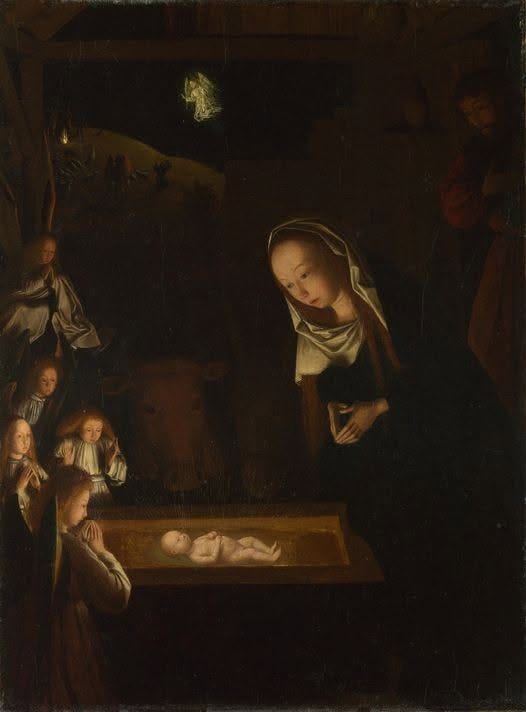
Saint Bridget of Sweden's Vision of the Nativity Influenced Artists' Depiction.
.
Shortly before her death, Saint Bridget described a vision of the infant Jesus as lying on the ground, and emitting light himself:
.
" the virgin knelt down with great veneration in an attitude of prayer, and her back was turned to the manger ... And while she was standing thus in prayer, I saw the child in her womb move and suddenly in a moment she gave birth to her son, from whom radiated such an ineffable light and splendour, that the sun was not comparable to it, nor did the candle that St. Joseph had put there, give any light at all, the divine light totally annihilating the material light of the candle ... I saw the glorious infant lying on the ground naked and shining. His body was pure from any kind of soil and impurity. Then I heard also the singing of the angels, which was of miraculous sweetness and great beauty ..."
.
Celestial Revelations Saint Bridget of Sweden.
.
Many depictions reduced other light sources in the scene to emphasize this effect, and the Nativity remained very commonly treated with chiaroscuro through to the Baroque. Here the sources of light are the infant Jesus himself, in accordance with Bridget's vision, who is the sole source of illumination for the main scene inside the stable, the shepherds' fire on the hill behind, and the angel who appears to them.
.
Night scenes had been developed in illuminated manuscripts before moving to panel paintings. Nativity at Night by van der Goes has been lost, but is inferred from works based on his. Night Nativity by Geertgen tot Sint Jans is in the National Gallery, London. Nativity by Michael Sittow is in the Kunsthistorisches Museum, Vienna, Austria.