
Reflections on Mater Admirabilis.
.
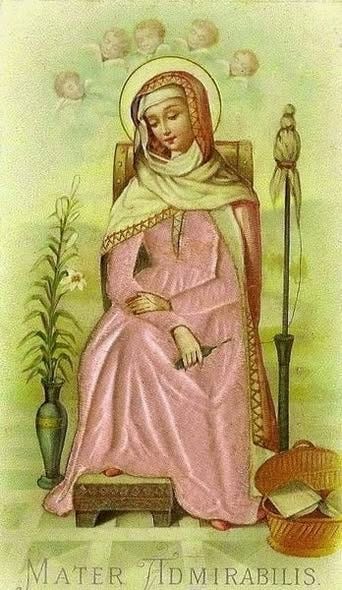
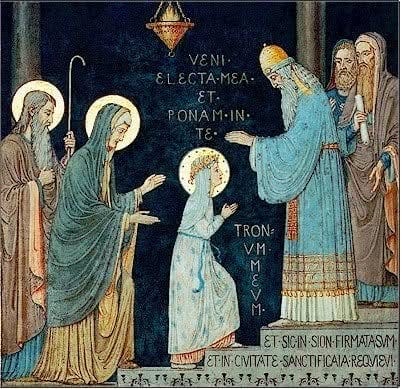
Though it is not recorded in Scripture, tradition holds that Mary was presented in the Temple when she was about four years old. Her parents, Joachim and Anna took Mary to the Temple and left her there in dedication. Mater Admirabillis (Mother Most Admirable) is the title of Our Lady as she is pictured in the Temple during her early teenage years. The original Mater is a fresco (a painting on wet plaster) on a wall in the Trinita dei Monte in Rome. It was painted in 1844 by a young Novice, Pauline Perdrau. The favorite color of Sister Pauline was pink, so she painted the young Mary in a pink dress.
.
Let‟s look at this photo of Mater. She has stopped her work with the yarn; she has put down her prayer book; she has lowered her eyes and has turned to God within. Reverend Mother deLescure called her the mother of the invisible and the essential. Mater reminds us to stop a minute and spend some time with God. Mary‟s habit of turning to God helped her throughout her life. Luke tells us, “Mary kept all these things and pondered them in her heart.” (Luke 2:19) When we do not understand all the events in our life, when we wonder if we can get through them, Mater encourages us to take these events to God and ask for help.
.
If we study Mater we will find in her the attitudes necessary to live our whole lives in response to the call of God. Good portrait artists are known for capturing the essence of a person in their pictures. They capture something, which helps us to understand their subjects. I think that in Mater, Pauline Perdrau has done just that. I believe that studying the portrait of Mater can reveal to us who Mary is, and what her life is all about. Look at Mater. What do you see? What characterizes her? Note the inwardness, the attitude of contemplation.
.
Looking at the picture, one would not be surprised to see the angel Gabriel appear. Hear the greeting: “Hail full of grace! The Lord is with thee. Blessed art thou among women. Thou wilt conceive in thy womb and bear a Son, and thou shalt name Him Jesus”.
.
Full of grace! That is what Mary is – full of God’s presence. There is
no sin in her blocking that presence. Mary is attuned to God and ponders His word in her heart. Therefore, she can discern what God calls her to do. Yet this inwardness, this contemplation leads to great action. The love of God urges us. And Mary sets out, led by the Spirit, to visit her cousin Elizabeth who, according to the angel, is in her sixth month of pregnancy.
.
Picture Mary arriving at the home of her cousin and greeting Elizabeth. Look at the two women embracing each other: Elizabeth, old grey, in her late stages of pregnancy, Mary, young, vital, her arm around Elizabeth. Listen to the conversation. Elizabeth cries out: “Blessed art thou amongst women and blessed is the Fruit of thy womb. How does this happen to me that the mother of my Lord shouldst come to me? For at the moment the sound of thy greeting reached my ears, the infant in my womb lept for joy. Blessed art thou who believed that which was spoken to thee by the Lord would be fulfilled”. And Mary responded: “My soul proclaims the greatness of the Lord and my spirit rejoices in God my Savior. For He has looked upon His handmaid’s lowliness for behold from now on all ages will call me blessed. The Mighty One has done great things for me and holy in His Name.”
.
Her grace and contemplative attitude enable her to discern and recognize the action of God in her life. We can see operative in this scene of the Visitation those key characteristics which were captured in the Mater portrait: the inwardness, the attitude of contemplation.
.
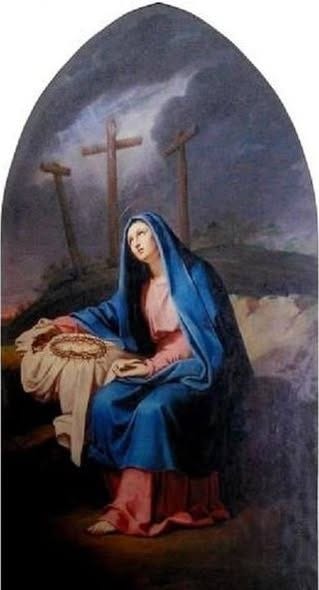
Let us look at one final scene, the Crucifixion. See Golgotha where
they crucified Jesus. And with him were two others -one on either side, with Jesus in the middle. Standing by the cross of Jesus were his mother, and his mother’s sister Mary the wife of Clopas, and Mary of Magdala. Look at Mary! She stands at the foot of the cross. She does not faint; she does not collapse. And in her face is both extreme agony and graced filled faith. This scene conjures up all the anguish and desolation a women could experience who had born a child, and raised that child only to have him crucified. Nonetheless, we see in this scene the same trust, the same faith that we glimpsed in the Mater portrait. However, now we see it in its maturity, its fulfillment. Mary stands supported by the presence of God, the grace of God. Mary remains open and accepting of the sometimes hard grace of God.
.
Mary leaves us a legacy of faith and hope in the living God. If we live as she did, open to the presence and grace of God we too will be bearers of Christ bringing Him to our world. Mater Admirabilis, pray for us.