
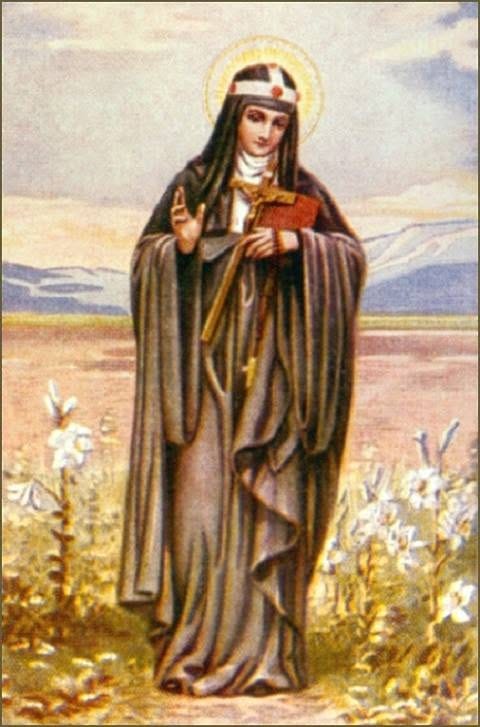
October 8 Saint Bridget of Sweden, “Spokewoman of God”; “Mystic of the North”.
1303-1373
Patronage:
Europe
Sweden
widows
.
Saint Bridget lived a life of special communion with Our Blessed Mother and Our Lord, Jesus Christ. From an early age, she enjoyed the privilege of visions and communication with the Holy Family, which she diligently reported to her confessors, who in turn recorded them, leaving detailed descriptions for the faithful. She is remembered for her astonishing revelations and visions of biblical scenes, especially the nativity and the crucifixion. These descriptions have greatly inspired imagery in Christian art and her devotions have inspired popular piety. Her practical side, especially her charitable heart, led to her canonization and recognition as the patron saint of Europe.
.
Saint Bridget was born in Finista, Sweden, into the Swedish royal family, the daughter of virtuous Christian parents. Before her birth, her mother was saved from a shipwreck, so as to preserve Bridget for the world. Moreover, prophetic occurrences predicted the birth of Bridget, including her bishop who proclaimed her “voice would be heard with admiration by the entire world.”
.
Despite the foretelling of great things to come, Bridget failed to speak as an infant for three years, remaining completely mute. At age three, holy legend tells us that she suddenly acquired speech, communicating clearly and eloquently, like that of a mature adult. At age seven, following the death of her mother, Saint Bridget was graced with a vision of Our Blessed Mother, who appeared, presenting Bridget with a beautiful crown. Following this sacred encounter, Bridget embraced the Christian virtues, becoming modest, humble, and peaceful—significantly more so than one would expect for a girl her age.
.
At age ten, following a sermon at Church in which the priest spoke of the Passion of Our Lord, Bridget began praying to better understand the suffering of Jesus, and was rewarded with a vision of Christ as He appeared on the Cross, His sacred blood fresh and flowing freely. From that moment on, Bridget continuously meditated on the mysteries of the Passion, frequently being moved to tears by the suffering of Jesus.
.
At age thirteen, Bridget married Ulpho of Sweden, Prince of Nericia, in obedience to her father’s wishes. Together, they parented eight children, four boys and four girls, one of whom, Saint Catherine of Sweden, is honored as a Saint. Saint Bridget and her husband, under her influence, devoted themselves and their family to a life of piety. She occupied her days instructing her children in the ways of the faith. Similarly, she devoted herself zealously to serving the sick and poor, establishing homes for their care, and despite her status as royalty, washing and kissing their feet. Despite harsh penances and fasting she personally practiced, Saint Bridget served meals to twelve individuals each day, selecting the poorest, neediest, and most undesirable for the honor.
.
Sadly, Bridget and Ulpho’s four sons died quite young, two in childhood, two during the crusades. After some years she and her husband felt drawn to the religious life and separated by mutual consent. Ulpho entered the Cistercian Order, and passed away shortly thereafter. After his death, Bridget’s life became still more austere, and she joined the Third Order of St. Francis, spending much of her time in prayer and penance. She spent her days in prayer and contemplation, as well as continuing her charitable work. Bridget established hospitals and convalescent homes throughout Europe. Following instruction from Our Lord, Saint Bridget founded the Order of the Holy Savior (the Bridgettines), and established a double monastery (for both men and women) at the Abbey of Vadstena in Sweden.
.
Saint Bridget received a series of sublime revelations, all of which she scrupulously submitted to the judgment of her confessor. Written down for the faithful, these visions often focused on moments of the life of Christ, including the Nativity and Passion.
.
Bridget on the Crucifixion, speaking of Christ: “He ascended gladly like a meek lamb led to the slaughter (and) extended his arms and opened his right hand and placed it on the cross. Those savage torturers monstrously crucified it, piercing it with a nail through that part where the bone was more solid. And then with a rope, they pulled violently on his left hand and fastened it to the cross in the same manner. Finally they extended his body on the cross beyond all measure; and placing one of his shins on top of the other the fastened to the cross his feet, thus joined, with two nails… Then the crown of thorns, which they had removed from his head when he was being crucified they now put back, fitting it onto his most holy head. It pierced his awesome head with such force that then and there his eyes were filled with flowing blood ad his ears were obstructed… And as I, filled with sorrow, gazed at their cruelty, I then saw his most mournful Mother lying on the earth, as if trembling and half dead. She was being consoled by John and by those others, her sisters, who were then standing not far from the cross on the right side. Then the new sorrow of the compassion of that most holy Mother so transfixed me that I felt, as it were, that a sharp sword of unbearable bitterness was piecing my heart.”
.
Bridget on the Nativity, described seeing Mary giving birth, as if “light passed through her body.” Joseph had provided a candle, to illuminate the dark stable in the night. With the birth of the Savior, however, the candlelight was overcome by a divine light which bathed the Holy Family: “Her [Mary’s] back was turned against the manger. Verily though all of a sudden, I saw the glorious Infant lying on the ground naked and shining… Then I heard also the singing of the angels, which was of miraculous sweetness and great beauty … When therefore the Virgin felt that she had already born her Child, she immediately worshipped him, her head bent down and her hands clasped, with great honor and reverence and said to him: Be welcome my God, my Lord, and my Son.”
.
As she grew older, Bridget felt a call to pilgrimage to Rome and the Holy Land, at the command of Jesus. Drawn to the site of the Passion, she traveled Rome, and then to Jerusalem. During this pilgrimage, the Lord dictated to her the “Fifteen Prayers of Saint Bridget,” in honor of His Passion.
.
Upon on her return from Jerusalem to Rome, Saint Bridget was overcome by fever, and suffered in Rome for one year. Having foretold her own death, she died peacefully. Her body was translated to her monastery of Vadstena, where multiple miracles have been recorded at her intercession.
.
Saint Bridget leaves a legacy of charity, visions, and prayer. Having dedicated herself to Our Lord, and struggling to understand His suffering and passion, Saint Bridget continues to glorify the Lord from her rightful place in heaven. We pray for her intercession, her faith, and her heart of service.
.
Eternal Father, I wish to honor St. Bridget of Sweden, and I give Thee thanks for all the graces Thou hast bestowed upon her. I ask Thee to please increase grace in my soul through the merits of this saint, and I commit the end of my life to her by this special prayer, so that by virtue of Thy goodness and promise, St. Bridget of Sweden might be my advocate and provide whatever is needed at that hour. Amen.