
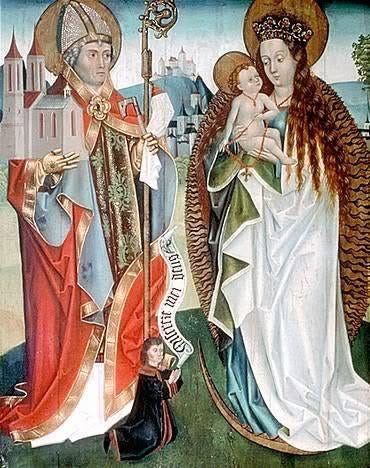
October 31 Saint Wolfgang of Ratisbon (Wolfgang of Regensberg): Missionary, priest, and bishop.
924-994
Patronage:
against apoplexy
against paralysis
against stomach diseases
against strokes
apoplexics
carpenters
woodcarvers
paralysed people
stroke victims
Regensburg, Germany, diocese of
.
Throughout his life, Saint Wolfgang worked to reform the Church and those he encountered, encouraging them to greater faith, humility, and love for the Lord.
.
Wolfgang was born in Swabia (Germany), the son of a nobleman. As a child, he was educated by a friendly, local priest. As he advanced in age, he was sent to the abbey of Reichenau (on Lake Constanz) to continue his education. There, he met and befriended the man who would remain his “best friend,” Henry, the younger brother of the bishop of Wurzburg. In Wurzburg, the bishop had established a school, and Henry convinced young Wolfgang to travel with him to receive the finest education of the time.
.
Wolfgang excelled at academics, and came to be known as the best student of the school. With Henry, who was equally devout and pious, Wolfgang remained at the school as a teacher upon completion of his formal studies. Subsequently, Henry was elevated to the position of Archbishop of Trier, and again persuaded Wolfgang to accompany him to that city to teach in the cathedral school. There, Wolfgang met Saint Rambold, a monk known for his reform and zeal for the Lord, and joined him in strengthening the faith of the congregation and community there.
.
Upon Henry’s death in 964, Wolfgang left Trier to become a Benedictine monk, joining the community at Einseideln. Recognized at once for his teaching prowess, Wolfgang was immediately put in charge of the abbey school, which soon earned a reputation as the best in the region.
.
Wolfgang took his vows and was ordained by Saint Ulric in 971. His first priestly mission was to Hungary, but yielded nothing but disappointment. However, despite the poor outcome, he was appointed as bishop of Regensburg by Emperor Otto II and Saint Rambold. While Wolfgang would have preferred to retire to a quiet monastic life, he obediently accepted the position. Contrary to the practices of the day, Wolfgang continued to dress in his monk’s robes and declined the live of riches and privilege typical of bishops at that time.
.
Once in place, Saint Wolfgang undertook immediate reform of the clergy, monasteries, and convents in the city. He recognized that the people, without models to look up to in their clergy and religious, would slip into less than devout worship. In reforming the monasteries and convents, he reformed the entire region! With love and vigor, he shepherded his people, preaching widely and zealously. Saint Wolfgang modeled the love of Christ, giving all he had to those in greater need. Despite his profound service to those around him, he felt drawn to the monastic life he loved, attempting on multiple occasions to become a hermit. Each time, the love and need of the people drew him back to the city. He earned the name the Great Almoner, due to his preaching, his teaching abilities, his charity, and his care for lay people in his diocese.
.
The religious and laity of the diocese of Regensburg came to appreciate the idealism and courage and holiness of their bishop. When he died in 994 while on a trip down the Danube, his body was brought back and enshrined in Regensburg. It quickly became a center of pilgrimage, and many miracles have been recorded at his tomb. In 1054, Pope Saint Leo IX canonized Saint Wolfgang as a model of the bishop who is ready to correct as well as direct the flock entrusted to him.
.
Eternal Father, I wish to honor St. Wolfgang of Ratisbon, and I give Thee thanks for all the graces Thou hast bestowed upon him. I ask Thee to please increase grace in my soul through the merits of this saint, and I commit the end of my life to him by this special prayer, so that by virtue of Thy goodness and promise, St. Wolfgang of Ratisbon might be my advocate and provide whatever is needed at that hour. Amen.