
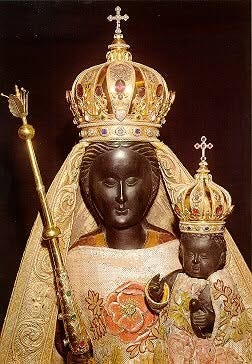
October 24 Our Lady of the Hermits (The Black Madonna of Einsiedeln)
.
The origin of the celebrated pilgrimage of Our Lady of the Hermits, the Loretto of Helvetia, goes back to the heroic times of Charlemagne. The saint who first inhabited the hermitage of Einsiedeln, was a young lord of Suabia, named Meinrad, belonging to the illustrious family of the counts of Hohenzollern.
Gifted with that genius of reverie which still forms the prominent feature of the German character, Meinrad, when scarcely arrived at adolescence, loved to buy himself in the thickest parts of the woods, which then covered his country, and to entertain himself alone with God, by the sound of bubbling springs, flowing beneath the shade of oaks.
.
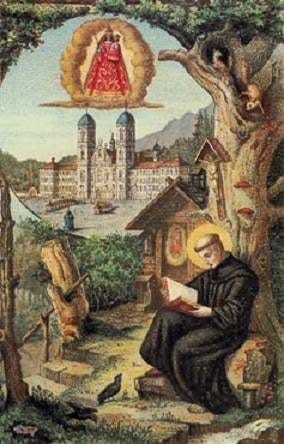
Oftentimes night overtook Meinrad attentively reading the Scriptures in an old book with golden clasps, which he had inherited from his fathers, or meditating profoundly on the miracles and benefits of the Blessed Virgin. His soul was elevated in solitude; taking pity on the world and its worthless goods, Meinrad made his vows in the Abbey of Richenau, which he quitted afterwards to settle in a small hermitage built on the top of Mount Etzel.
.
Meinrad spent seven years there; but the good odor of his virtues descended to the depths of the valleys; the shepherd and woodmen came to him, then the great lords, then the noble ladies, humbly to solicit his prayers and counsels. These acts of homage were a torment to the young hermit, who loved nothing but contemplative prayer and the peace of the woods; one night he secretly left his hermitage, carrying with him, as his sole possession, the statue of the Blessed Virgin, Our Lady of the Hermits, the only ornament of his chapel, and took refuge in a forest of the canton of Schwytz, which bore the characteristic name of the Dark Forest.