
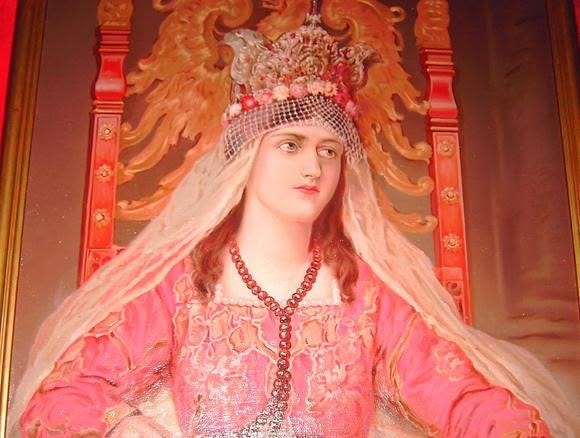
October 16 Saint Hedwig ((Jadwiga Slaska,Hedwig of Silesia, Hedwig von Andechs, Hedvigis, Avoice): Duchess of Poland and Widow
(† 1243)
Patronage:
against jealousy
brides
duchesses
death of children
difficult marriages
widows
orphans
Görlitz, Germany, diocese of
Andechs Abbey, Bavaria, Germany
Bavaria, Germany
Berlin, Germany
Brandenburg, Germany
Kraków, Poland
Silesia
Trzebnica, Poland
Wroclaw, Poland
.
Saint Hedwig was the wife of Henry, Duke of Silesia and Poland, and the mother of six children. To one of her sisters, married to the King of Hungary, was born the future Saint Elizabeth of Hungary; another was the wife of Philip-Augustus of France, and the third, Abbess of a celebrated monastery at Lutzingen. Saint Hedwig led a humble, austere, and holy life amid all the pomp of her royal state. While still young, she and her spouse made a solemn vow of chastity, ratified by their bishop. Her house was a school of piety and good order; with Duke Henry she built the large monastery of Trebnitz, where she placed nuns of the Order of Citeaux.
.
Inspired by these holy examples, the Secretary of State of the Duke and Duchess left the court and dedicated all his wealth to the construction of a Cistercian monastery, which he then entered, to spend there the rest of his life.
.
Saint Hedwig attended to the needs of all the monasteries and the hermits of the region, visiting them herself and taking them clothing, food and all she judged necessary. She visited prisoners and saw that they did not suffer from the cold or from lack of light. She cared for the poor and served them herself in her residence. On Holy Thursday she washed the feet of several lepers, remembering the lessons of Our Saviour. She fasted often and walked barefoot in the snow when she prayed; she slept on the ground.
.
Devotion to the Blessed Sacrament was the keynote of her life. She considered it her very great privilege to supply the bread and wine for the Sacred Mysteries, and each morning would attend as many Masses as were celebrated. After the death of her husband in 1238, she retired to the Cistercian convent of Trebnitz, where she lived under obedience to her daughter Gertrude, abbess of that monastery, growing day by day in holiness, until God called her to Himself in the year 1243. She was canonized twenty-four years later, by Pope Clement IV. This Pontiff, during the ceremony of her canonization, asked God through her intercession to cure a girl who was blind, and the cure was immediately effected. Saint Hedwig is buried in the church of Trebnitz.
.
Eternal Father, I wish to honor St. Hedwig, and I give Thee thanks for all the graces Thou hast bestowed upon her. I ask Thee to please increase grace in my soul through the merits of this saint, and I commit the end of my life to her by this special prayer, so that by virtue of Thy goodness and promise, St. Hedwig might be my advocate and provide whatever is needed at that hour. Amen.