
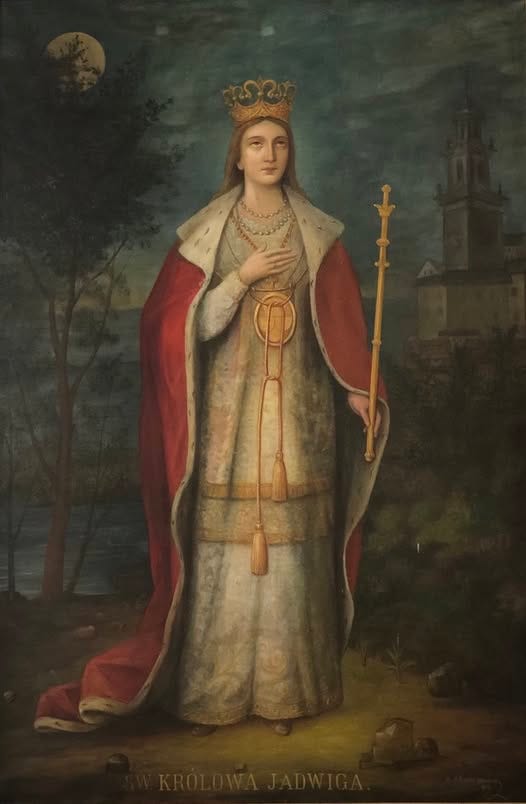
October 16 Saint Hedwig (Jadwiga Slaska,Hedwig of Silesia, Hedwig von Andechs, Hedvigis, Avoice), OSB Cistercian: Queen Religious.
Born in Bavaria c. 1174
died in Silesia, 1243
Patronage:
against jealousy
brides
duchesses
death of children
difficult marriages
widows
orphans
Görlitz, Germany, diocese of
Andechs Abbey, Bavaria, Germany
Bavaria, Germany
Berlin, Germany
Brandenburg, Germany
Kraków, Poland
Silesia
Trzebnica, Poland
Wroclaw, Poland
.
Hedwig was one of the eight children born to Berthold IV, the count of Andechs, who ruled over the Tyrol and Istria (Croatia and Dalmatia). Two of her brothers became bishops and two of her sisters became queens. One of them, Gertrude, who married Andrew II of Hungary, was the mother of Saint Elizabeth of Hungary.
.
As a child she was placed in the Benedictine monastery of Kitzingen in Franconia (see Saint Thecla).
.
In 1186, when she was 12 years old, Hedwig was married to 18-year- old Henry the Bearded, prince of Poland and future duke of Silesia. She bore him 6 (some say 7) children and the family was closely knit. But from 1209 onwards she and her husband agreed to live in perpetual continence. Hedwig was then 35 and Duke Henry was barely past 40, but he submitted to the austere disciple without complaint or resistance.
.
After succeeding to his father’s dukedom in 1202, and under Hedwig’s influence, Henry founded the monastery of Cistercian nuns at Trebnitz (near Breslau, now Wroclaw), the first convent of women in Silesia. The convent was built with the labor of those convicted of crimes. It was the first of a large number of such establishments founded by the couple, including houses of Augustinian canons, Cistercian monks, and Dominican and Franciscan friars, by which religion and German culture were spread over their territories.
.
Henry also founded the Hospital of the Holy Ghost in Breslau, and Hedwig founded a hospital for female lepers.
.
Following the example of his wife, he was sustained by a great and ennobling piety. He let his beard grow in the manner of Cistercian converts (when his name Henry the Bearded) and greatly reduced his household expenses, devoting the money that he saved to charitable purposes. After their separation Henry never again wore gold, silver, or purple.
.
There have been few duchesses like her. She was humble, serving the poor and the lepers, pardoning offenses, helping her enemies, and bringing aid to even the most insolent and hardened sinners. She kept barely a hundredth part of her income, giving the rest away with an open hand. Beneath her tattered cloak she wore a hair shirt. She went about with naked feet in all weather, and when, in obedience to her confessor, she bought a pair of new shoes, she carried them under her arms. She scourged herself and subjected her soul and her body to countless mortifications.
.
Towards the end of her life she had the gift of working cures and making predictions. Several miracles are recorded of her--she fell asleep, it was said, one night while reading the Bible by candlelight; the book caught fire and burned, but was undamaged. A blind man’s sight was restored because of her blessing.
.
As for Henry I, her good and faithful husband, she outlived him by five years. In 1227, Henry engaged in fighting Conrad of Masovia for the land of Ladislaus of Sandomir who had been killed in battle. Henry triumphed and established himself at Cracow, but he was kidnapped during Mass and taken by Conrad to Plock. Hedwig followed and helped bring the two to a peaceful agreement, which included the marriage of her two granddaughters to Conrad’s sons. Upon Duke Henry’s death in 1238 Hedwig moved into the monastery at Trebnitz. Hedwig did not cry at her husband’s death; she consoled the sorrowing nuns instead.
.
God treats harshly those whom he loves. All her children died before she did, except for one daughter, Gertrude, who was the abbess of the convent of Trebnitz. Two of her sons dishonored the family name by engaging in fratricidal wars, and another son, Henry the Pious who succeeded his father, was killed in 1241 by the Tartars at the battle of Liegnitz. Again, Hedwig comforted the others.
.
She took the habit of the nuns but not the vows, wishing to administer her property as she wished to help the needy. She predicted her own death, insisting on being anointed before anyone else would acknowledge she was in danger. Worn out by the hardships she had endured, she died in 1243, in her seventieth year.
.
Riches have never been able to buy entrance into heaven. Hedwig, the duchess with the naked feet and workworn hands, had no need to knock on the gates which, at her approach, swung open of themselves. And someone was on the threshold to greet with open arms the woman who had freely given of her heart, her wealth, and her light, and who had been a supreme example of the life of poverty in the example of God (Attwater, Bentley, Delaney, Encyclopedia, White).
.
The policies and foundations of Duke Henry and Saint Hedwig were important in Silesian history through the increase of German influence they brought to the country (Attwater).
.
She is the patroness of Silesia, and venerated in Franconia.
.
Depicted in art with the church and a statue of the Virgin Mary in her hands; or washing the feet of the poor; or barefoot with her shoes in her hands; or in a religious habit with the robes and crown of a princess near her (White). Sometimes she is seen holding a picture of the Virgin and Child in her hand or Christ blessing her from the Cross (Roeder).
.
Canonized 26 March 1267 by Pope Clement IV.
.
Eternal Father, I wish to honor St. Hedwig, and I give Thee thanks for all the graces Thou hast bestowed upon her. I ask Thee to please increase grace in my soul through the merits of this saint, and I commit the end of my life to her by this special prayer, so that by virtue of Thy goodness and promise, St. Hedwig might be my advocate and provide whatever is needed at that hour. Amen.