
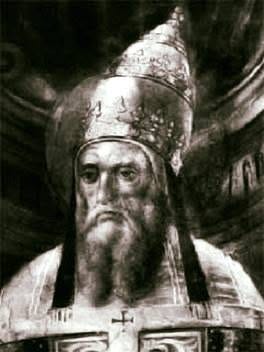
October 14 Pope Saint Callistus I: Defender of the Holy Trinity, and Martyr of the Church.
died 223
.
As the sixteenth pope, his most important acts were to decree that grave sinners and lapsed Christians – those who folded in the face of martyrdom – were to be allowed to return to Communion after having repented and performed penance. He also decreed that, contrary to Roman law, there were no barriers to marriage between different social classes, and that where Church law and civil law clash, Church law takes precedence. While little is recorded about him in Church records—and those that survive were written by a sworn enemy—many scholars view Pope Saint Callistus I as one of the greatest popes in early Church history.
.
Callistus was born to a Christian slave owned by Carpophorus, a Christian in the household of Caesar in second-century Rome. He was placed in charge of a Christian bank which went broke after many of the citizens monies were loaned to failed to pay them back. Knowing that he would suffer blame for the bank’s failure, Callistus fled the city, but was caught and returned to his owner. While he wasn’t a thief, he was still sentenced to the treadmill, then later to the tin mines where he slaved many years. Eventually, along with other Christians, he was later ransomed and returned to Rome, becoming a free man. Pope Saint Zephyrinus selected Callistus to oversee the Roman public burial grounds in Rome, today known as the Cemetery of Saint Callistus. He was eventually made a deacon, and then elevated to archdeacon. In this role, Callistus was responsible for the administration of the Church's property, the oversight of clergy, and organization of the burial of martyrs in the catacombs on the Apian Way. During his time, the Church began to build churches, which though destroyed during the various persecutions, were eventually rebuilt.
.
Eighteen years after having his freedom purchased, Callistus succeeded Zephyrinus as pontiff, the sixteenth pope. As pope he regulated the discipline of the sacrament of penance, ruling that penitent sinners were welcome in church. He defended the faith against the Adoptionist and Modalist heresies regarding the Holy Trinity and the Person of Jesus Christ. Regarding forgiveness of sinners, Pope Callistus, more aligned with the sentiments of Jesus, saw the Church as a place for continuously reclaiming the repentant sinner. He was, on more than one occasion, accused of heresy—especially in regards to his proclamations regarding penance and Communion, and marriage across economic classes. His leadership of the Church put him in conflict with Roman civil law, but he stated that in matters concerning the Church and the sacraments, Church law always trumped civil law. While he had many critics, Pope Saint Callistus I taught what the Church has taught for centuries, including today.
.
Pope Saint Callistus I is held to have initiated a practice in the Church known as Ember (meaning four times per year) Days, to bring down blessings on each season of the year. Within the liturgical year, the Church designated a group of three days which were set aside for fast and abstinence. This observation occurred four times during the course of the liturgical year. The practice, which was observed for centuries, has since faded.
..
During the pontificate of Saint Callistus, the reign of Alexander Severus began, who actively engaged in persecution of Christians. Callistus was forced to take shelter in the poor quarters of Rome, hiding from authorities. Calipodius, a priest who would be martyred, appeared to him, saying: “Father, take courage; the hour of the reward is approaching; your crown will be proportionate to your sufferings.” Soon afterwards Callistus was discovered, and the house in which he was hiding was guarded by soldiers who received the order to allow no food to enter it for days. After this initial starvation, Saint Callistus was martyred. With a rock suspended from his neck, he was thrown from a window into a well in 223. His body was recovered by the faithful, and he is entombed in a cemetery along the Via Aurelia.
.
While we do not know much of Pope Saint Callistus I, it is clear that he embraced the teachings of Christ, was generous and forgiving in dealing with sinners, believed in the principles of copious redemption, and espoused the still-held Church teachings that mercy restores to love. His writings—especially encouraging letters—remain, encouraging us today to look to Christ for instruction in the ways we treat others; to not judge based upon past deeds; to forgive and be merciful as the Lord forgives and is merciful.
.
God of mercy,
hear the prayers of Thy people
that we may be helped by St. Callistus,
whose martyrdom we celebrate with joy.
We ask this through our Lord Jesus Christ Thy Son,
Who livest and reignest with Thee and the Holy Ghost,
one God, for ever and ever . Amen.