
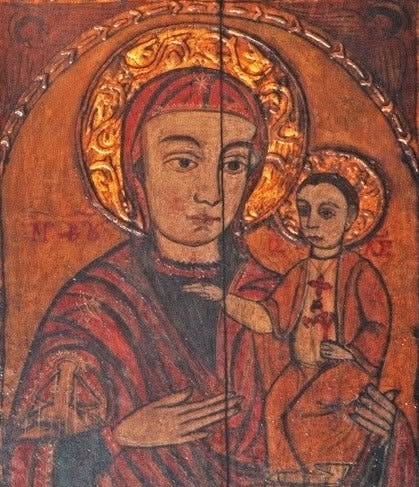
November 4 Könnyezo Szuzanya (”Weeping Virgin” Odigitria Icon) Máriapócs, Hungary (1696)
.
According to tradition, on 4 November 1696, the faithful who were attending Mass in the small Greek-Catholic village church saw the Virgin of the “Odigitria” icon weeping tears. The phenomenon repeated itself until December 8, and was witnessed by a great number of people flocking from neighboring villages. The priest saved these “precious pearls of mercy” tears in a silk handkerchief and sent them to the bishop, who had them examined by ecclesiastical and lay witnesses. The results of these examinations were unanimous.
.
The royal family became interested in the prodigy as well. Emperor Leopold I ordered that the icon of the crying Virgin be transferred to Vienna and exhibited inside the cathedral. In the capital, this miraculous icon instantly became the object of a great veneration among the faithful, who invoked her in all necessities, especially during the war against the Turks, who were definitively expelled from the Autrio-Hungarian territory in 1697.
.
Meanwhile, a copy of the icon, placed in Mariapocs, also began to shed tears in 1715, during the first half of the month of August. Pilgrims came in great numbers and the civil authorities decided to build a larger church. The construction began in 1749, but the interior was only completed in 1946. The afflux of pilgrims in the course of the following two centuries increased steadily, partly because of a third miraculous lacrimation in 1905 which lasted more than a month.
.
History
.
Captured by Turks and held as a prisoner of war, Laszlo Csigri celebrated his release in 1696 by commissioning a wooden icon of the Virgi and Child for the Greek Catholic church in his home town of Pócs (pronounced Poach) in eastern Hungary. The artist was the pastor’s brother, Istvan Papp; although he had studied in Italy, the work has a primitive immediacy more typical of Coptic art than of the Italian baroque. In a variation of the classic hodigetria or way-pointing pose, the Virgin not only gestures toward the Child, who wears a cross and holds a three-petaled flower; he points back toward her. That same year, on November 4, toward the end of the mass, a farmer named Mihaly Eory noticed the icon was shedding tears. During the two weeks of this first weeping, word spread throughout the area. A dying child recovered when held up to the tears by a Roman Catholic priest from a town ten miles away. In gratitude, the mother gave the icon a jeweled necklace, the first of many such offerings, which eventually covered the image almost completely. In December, it wept for another two weeks, starting on the 8th. Pócs became known as Máriapócs. Hungary was then under Austria, and in February, 1697, Emperor Leopold II had the miraculous image moved to St. Stephen’s Cathedral in Vienna. It’s still there, in a chapel to the right of the entrance. It never wept again. But a copy given by the Emperor to the church in Máriapócs wept three more times, in 1715, 1750, and 1905.
.
November 4, 1696, the faithful who attended the Mass in the Greek-Catholic Church of the village saw the Virgin of Hodigitria icon pour tears.
.
The phenomenon is repeated until 8 December and was witnessed by a huge crowd came also from neighboring countries.
.
The priest gathered in a silk handkerchief these precious pearls of “mercy” and sent to the Bishop of Eger, the investigation confirmed the supernatural origin of the phenomenon.
.
The Emperor Leopold 1 while the icon was transferred to Vienna in the Cathedral of S. ordered Etienne.
This miracle makes sense in the history of Hungary:
.
Budapest was occupied in 1541 by the Ottoman (Turkish Muslims), and was released in 1686. In 1693, Emperor Leopold I was then renewed national entrustment to Mary. It is in 1696 that takes place the miracle of tears on “Hodigitria” icon Máriapócs. And it is in 1697 that the Turks are finally driven the Austro-Hungarian territory.
.
Second and third lacrimation (1715 and 1905):
.
While the original icon was placed in Vienna, a copy of the icon was put to Máriapócs and it wept again in 1715, from 1 to 15 August.
.
A third lacrimation happened in 1905 and lasted a month.