
Lessons 7 - 9 from the Divine Office for the Twenty-First Sunday after Pentecost: Matth. 18: 23-35; Book 3 of Commentaries on Matthew, chapter 18 by St. Jerome the Priest.
.
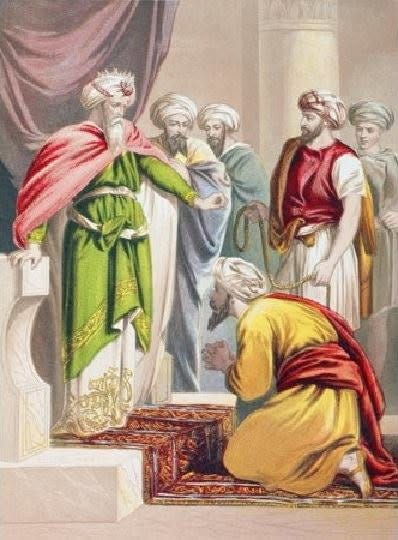
At that time, Jesus spake this parable unto His disciples: Therefore is the kingdom of heaven likened unto a certain king, which would take account of his servants. And when he had begun to reckon, one was brought unto him, which owed him ten thousand talents. But forasmuch as he had not to pay, his lord commanded him to be sold, and his wife, and children, and all that he had, and payment to be made. The servant therefore fell down, and worshipped him, saying, Lord, have patience with me, and I will pay thee all. Then the lord of that servant was moved with compassion, and loosed him, and forgave him the debt. But the same servant went out, and found one of his fellow servants, which owed him an hundred pence: and he laid hands on him, and took him by the throat, saying, Pay me that thou owest. And his fellow servant fell down at his feet, and besought him, saying, Have patience with me, and I will pay thee all. And he would not: but went and cast him into prison, till he should pay the debt. So when his fellow servants saw what was done, they were very sorry, and came and told unto their lord all that was done. Then his lord, after that he had called him, said unto him, O thou wicked servant, I forgave thee all that debt, because thou desiredst me: Shouldest not thou also have had compassion on thy fellow servant, even as I had pity on thee? And his lord was wroth, and delivered him to the tormentors, till he should pay all that was due unto him. So likewise shall my heavenly Father do also unto you, if ye from your hearts forgive not every one his brother their trespasses.
--------------------------------------------------------
It is a way much in use with the Syrians, and especially with the inhabitants of Palestine, to illustrate their discourse with parables, that what their hearers may not be able to catch so easily when spoken plainly, they may lay hold on by dint of comparisons and examples. Thus it was that the Lord, by an allegory about a Royal master and a servant who owed him ten thousand talents, and who obtained by entreaty forgiveness of the debt, taught Peter how it was his duty to forgive his fellow-servants for their comparatively trifling offences. For if that Royal master so readily forgave his servant his debt of ten thousand talents, should not his servants much more forgive lesser debts unto their fellows?
To put this more clearly, let us take a case. If one of us were to commit adultery, or murder, or sacrilege, our sin, great like a debt of ten thousand talents, would be forgiven us in answer to prayer, if we also from our heart forgive our brethren their trespasses against us. But if we refuse to forgive a slight, and keep up unceasing enmity because of an unkind word, how just doth it appear that we should be cast into prison, and entail on ourselves, by the example of our own deeds, that our great debt should not be forgiven unto us.
So likewise shall my heavenly Father do also unto you, if ye from your hearts forgive not every one his brother their trespasses. God's awful purpose can be turned and changed; but if we will not forgive unto our brethren small things, God will not forgive us great things. And if we forgive them, it must be from our hearts. Any one can say: I have nothing against such-an-one; he knoweth what he hath done, and God will judge will him for it; I do not care what he doeth; I have forgiven him. But the Lord maketh his sentence clear, and destroyeth such a mockery of peace as this, where he saith: So likewise shall my heavenly Father do also unto you, if ye from your hearts forgive not every one his brother their trespasses.