
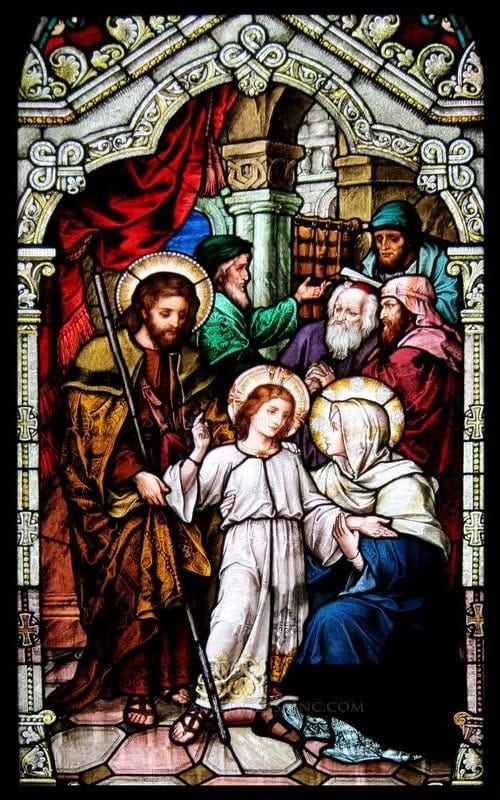
Lessons 7-9 from the Divine Office for The Motherhood of the Blessed Virgin Mary (The Divine Maternity of Our Lady) Luke 2: 43-51; Homily 1 on the Praises of the Virgin Mother by St. Bernard the Abbot.
.
At that time, when they returned, the child Jesus tarried behind in Jerusalem; and Joseph and His mother knew not of it. But they, supposing Him to have been in the company, went a day's journey; and they sought Him among their kinsfolk and acquaintance. And when they found Him not, they turned back again to Jerusalem, seeking Him. And it came to pass, that after three days they found Him in the temple, sitting in the midst of the doctors, both hearing them, and asking them questions. And all that heard Him were astonished at His understanding and answers. And when they saw Him, they were amazed: and His mother said unto Him, Son, why hast thou thus dealt with us? behold, Thy father and I have sought Thee sorrowing. And He said unto them, How is it that ye sought Me? wist ye not that I must be about My Father's business? And they understood not the saying which He spake unto them. And He went down with them, and came to Nazareth, and was subject unto them.
_________________________
Son, why hast thou thus dealt with us? Mary called God, the Lord of Angels, her son. Which of the angels would have dared to do so? It is enough for them, and they reckon it is a great thing, that, being naturally spirits, they should receive the grace of being made and called angels, as witness David: Who maketh spirits his angels. But Mary, knowing herself to be his Mother, doth boldly apply the word Son to that Majesty whom the angels do serve with awe; neither doth God despise to be called what he hath made himself. For a little after, the Evangelist saith: And he was subject unto them. Who to whom? God to men. I say that God, unto whom the angels are subject, and who is obeyed by the Principalities and Powers, was subject to Mary.
Marvel thou at both these things, and choose whether to marvel most at the sublime condescension of the Son, or at the sublime dignity of Mary. Either is amazing, either marvellous. That God should obey this woman, is a lowliness without parallel; that this woman should rule over God, an exaltation without match. In praise of virgins, and of virgins only, is it sung that These are they which follow the Lamb whithersoever he goeth. Of what praise then thinkest thou that she must be worthy who even leadeth the Lamb? O man, learn to obey. O earth, learn to submit. O dust, learn to keep down. It is of thy Maker that the Evangelist saith: And he was subject unto them. Blush, O proud ashes. God humbleth himself; and dost thou exalt thyself? God is subject unto men; and wilt thou, by striving to rule over men, set thyself before thy Maker?
O happy Mary, lowly and virgin; and wondrous virginity, which motherhood destroyed not, but exalted; and wondrous lowliness, which the fruitful virginity took not away, but ennobled; and wondrous motherhood, which was both virgin and lowly. Which of them is not wondrous? which of them is not unexampled? and which of them doth not stand alone? The wonder would be if thou wert not puzzled at which to wonder most―motherhood in a virgin, or virginity in a mother; a motherhood so exalted, or lowliness in such exaltation. But indeed more marvellous than any one of these things is the combination of them all, and without all comparison, it is more excellent and more blessed to have received them all, than to have received any one of them alone. What wonder is it that God, of whom we see and read, that He is wonderful in his holy places, should have shewn himself wonderful in his Mother? O ye that be married, honour this incorruption in corruptible flesh; O holy maidens, gaze in wonder at motherhood in a maid; O, all mankind, take pattern by the lowliness of the Mother of God.