
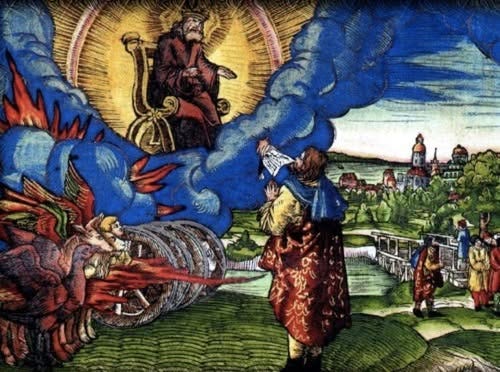
Lessons 4-6 from the Divine Office for the First Sunday in November: Book 1, Homily 2 on the Exposition of the Prophet Ezekiel by St. Gregory the Pope.
.
It is the use of the prophetic writers first to give name, date, and place, and then to begin to unfold the mysteries of their prophecy. On this wise a foundation is first laid down, to give beforehand a stability of trustworthiness, and afterwards the fruits of the Spirit are thereupon set forth by signs and in figures. Thus Ezekiel saith concerning the date: And it came to pass in the thirtieth year, in the fourth month, in the fifth day of the month. And to shew the place, he added further: As I was among the captives by the river Chebar, the heavens were opened, and I saw visions of God. Then he defineth the time even more exactly, saying: In the fifth day of the month, which was the fifth year of King Jehoiachin’s captivity. And that he may clearly índicate his own person, he goeth on further to state his kind, saying: The word of the Lord came expressly unto Ezekiel the Priest, the son of Buzi.
But at once a question is bound to arise as to why the Prophet beginneth his prophecy with the word: And: seeing that hitherto he hath said nothing. For the Prophet beginneth thus: And it came to pass in the thirtieth year. Now, this word And is a conjúnction, and we know that is so called because it conjoineth that which cometh after it with that which goeth before it. Wherefore then, doth he who hath hitherto been silent, commence by And, when there is nothing going before the conjúnction to join to that which cometh after? To explain this, we must consider that our senses perceive only things bodily, while those of Prophets perceive also the things which are spiritual, and to them things exist which to our ignorance seem not to do so. Hence it cometh that in the mind of the Prophet, things outer and inner are so joined that he seeth both together.
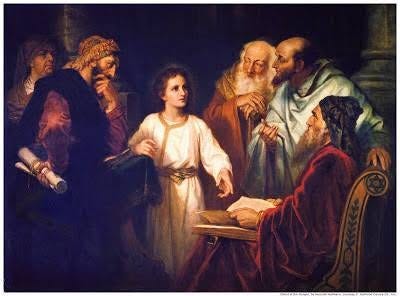
It appeareth plainly, therefore, that he which hath hitherto been silent, beginneth with the word: And it came to pass in the thirtieth year: because this his first utterance was but the continuation of something to which he had already been listening in his own mind. The words which he spake were merely a continuation of the vision already going on within, and therefore his first words are: And it came to pass: for this language is framed as though his inner revelation had been an open one. The fact that it was in the thirtieth year that the word of the Lord came unto Ezekiel, causeth us to remark that in the ordinary use of human understanding, men receive not a call to teach until they be of full age. Hence also even the Lord himself, when he sat in the Temple in the midst of the doctors, in the twelfth year of his age, was pleased to be found, not teaching, but hearing them, and asking them questions.