
Lessons 4-6 from the Divine Office for the Third Sunday of October: From the Treatise on Duties by St. Ambrose the Bishop.
.
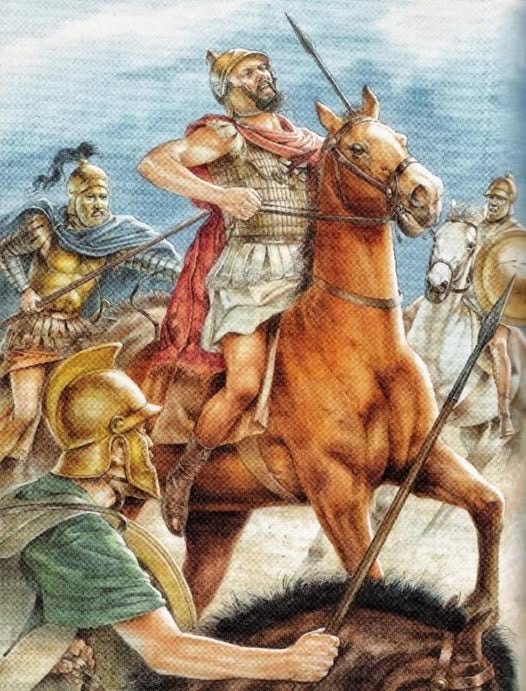
Because courage is proved not only by success, but also by misfortune, let us consider the death of Judas Maccabeus. For after he had conquered Nicanor, the general of King Demetrius, he was valiant enough to offer battle with his eight hundred men against a royal army of twenty thousand. And when his own troops wished to surrender, lest they should be overwhelmed by superior numbers, he persuaded them to choose a glorious death rather than a shameful flight, saying: Let us die manfully for our brethren, and let us not stain our honour. Therefore he joined battle, and after the strife had raged from dawn till evening, he attacked on the right wing, where he perceived the strongest forces of the enemy to be, and easily discomfited them. But when he followed up the retreating force, he exposed himself to an attack from the rear, whereby he was wounded unto death, which same was more glorious than a victory.
Why should I add anything concerning his brother Jonathan? This same was he, who in fighting with a small force against the royal armies, was deserted by his own troops, and left with two men only; and yet he renewed the battle, and discomfited the enemy, and recalled his own deserters to share this his triumph. Ye thus examples of warlike courage, wherein is no ordinary nobility and dignity, in that death was preferred to slavery and shame. But what shall I say of the sufferings of the Martyrs? And lest we should digress further, let us remember how the sons of the Maccabees gained no less a triumph over the proud King Antiochus, than did their fathers; as the latter overcame by arms so did the former without arms.
The unconquered band of seven boys stood encompassed by the royal legions; tortures failed, executioners became weary; but the martyrs failed not in their witness. One of them suffered the stripping of the skin from his head, whereby his outward appearance was changed, but his courage was increased. Another, when ordered to put forth his tongue that it might be cut off, thereby put forth his testimony, as it were, on this wise: The Lord, who heard Moses when he was silent, can hear them that speak not; yea, he heareth the silent thoughts of his own people more than the much speaking of other folk; and ye that fear the scourge of the tongue, fear ye not the scourge of blood? for blood, too, hath its own voice, which crieth unto God as crieth the blood of Abel.