
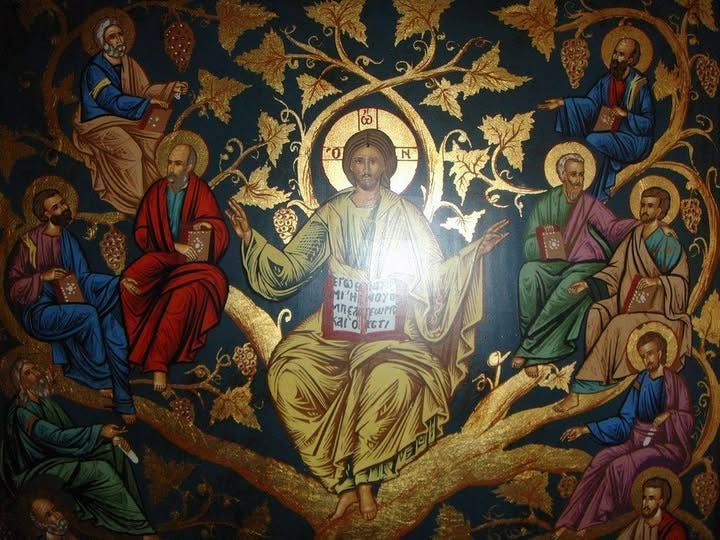
Lesson 7 - 9 from the Divine Office for the feast of the Holy Apostles Simon and Jude:John 15: 17-25; Treatise 87 on the Gospel of John by St. Augustine the Bishop.
.
These things I command you, that ye love one another. If the world hate you, ye know that it hated Me before it hated you. if ye were of the world, the world would love his own: but because ye are not of the world, but I have chosen you out of the world, therefore the world hateth you. Remember the word that I said unto you, The servant is not greater than his lord. If they have persecuted Me, they will also persecute you; if they have kept My saying, they will keep yours also. But all these things will they do unto you for My name’s sake, because they know not Him that sent Me. If I had not come and spoken unto them, they had not had sin: but now they have no cloke for their sin. He that hateth Me hateth My Father also. If I had not done among them the works which none other man did, they had not had sin: but now have they both seen and hated both Me and My Father. But this cometh to pass, that the word might be fulfilled that is written in their law, They hated me without a cause.
____________________________________________
In the reading from the Gospel, the last before this, the Lord had said: Ye have not chosen Me, but I have chosen you, that ye should go, and bring forth fruit, and that your fruit should remain: that whatsoever ye shall ask of the Father in My Name, He may give it you. And here He saith: These things I command you, that ye love one another. And by this it is that we must understand what fruit from us it is, whereof he saith: I have chosen, that ye should go, and bring forth fruit, and that your fruit should remain. And thus we may also come to understand the added words: That whatsoever ye shall ask of the Father in My Name, He may give it you. That is, the Father will give what we ask if we love one another. For love is itself the chief gift of Him Who hath chosen us when as yet we were fruitless. It is not we that chose Him, but He that chose us, and ordained us, that we should go, and bring forth fruit, which same is that we love one another.
Charity, then, is the fruit which we should bring forth, like as the Apostle Paul saith: The end of the commandment is charity out of a pure heart, and of a good conscience, and of faith unfeigned. And this is the charity wherewith we love our neighbour, namely, the charity wherewith we love God; for we do not truly love one another unless we love God. For everyone that loveth God also loveth his neighbour as himself. And he that loveth not God cannot even truly love himself. For on these two commandments hang all the Law and the Prophets. Love, then, is the fruit which we should bring forth. And when the Lord would give us a commandment concerning fruit, he saith: These things I command you, that ye love one another. Hence also the Apostle Paul, what time he commandeth the fruits of the Spirit as opposed to the works of the flesh, putteth love first of all. The fruit of the Spirit is love, saith he. And from that as the beginning he draweth out a string of other fruits, as thence begotten and thereto bound, namely: joy, peace, long-suffering, gentleness, faith, meekness, temperance, chastity.
What man is truly joyful that loveth not the cause of his joy? Who can truly live in peace, one with another, unless the one love the other? Who is cheerful and persevering under long and hard toil in good works, unless he be fervent in love? Who is kind, unless he love the object of his tenderness? Who is good, unless by the persuasion of love? Who is truly faithful, unless by the faith which worketh by love? Who is meek to any purpose, unless love move him? Who turneth away from baseness unless he love honour? Well then doth the good Master so often command us to love, as though that commandment were all-sufficient, for love is that gift without which all other good things avail nothing. Yea, love cannot be in us without bringing along every other good gift which maketh a man good.